


Stop Repossession of Your Home by the Bank
To stop repossession in Queensland, borrowers must understand that mortgage enforcement is not an instant process and that banks cannot simply take and sell residential property without complying with strict legal requirements.
Repossession disputes are governed by a combination of mortgage contracts, statutory protections, equitable principles, and court-supervised enforcement procedures, all of which may create opportunities to delay enforcement, negotiate repayment arrangements, challenge lender conduct, refinance the debt, or pursue hardship relief before a mortgagee sale occurs.
This article explains how repossession proceedings work in Queensland, what legal rights borrowers have after missed mortgage payments, when banks can seek possession orders, the practical options available to stop repossession, and the key risks borrowers face if enforcement action continues unchecked.
It also examines the statutory framework under the Property Law Act 2023 (Qld) and the National Credit Code, including the duties imposed on mortgagees during enforcement, the limits on a lender’s power of sale, and the legal principles courts apply when determining whether repossession should proceed. The High Court has recognised that, even where a mortgagee is exercising a contractual power, that power is not unfettered in its practical operation.
The Court stated in Commercial & General Acceptance Ltd v Nixon [1981] HCA 70 at [3]:
The mortgagee must exercise the power in good faith.
Further, Queensland legislation imposes an additional statutory obligation when a mortgagee proceeds to sale:
It is the duty of a mortgagee… to take reasonable care to ensure that the property is sold at the market value.
These principles become particularly significant once enforcement steps have commenced, as they define both the limits of lender conduct and the scope of borrower challenge.
Beyond statutory duties, equitable doctrines may operate to restrain enforcement in specific circumstances, particularly where the validity or fairness of the underlying security is in question.
Although such doctrines are not applicable in every repossession scenario, they form a critical part of the broader legal landscape and may, in appropriate cases, provide a basis for resisting enforcement altogether.
Importantly, the legal mechanisms available to a borrower will depend heavily on timing.
Different considerations arise before default, after default but prior to enforcement, and once possession or sale proceedings are underway.
Each stage engages distinct statutory provisions, procedural requirements, and potential remedies.
This article examines those stages in detail, focusing specifically on Queensland law, and identifies the legal and practical pathways through which repossession may be prevented, delayed, or challenged.
It also highlights key risks, limitations, and areas of legal uncertainty that may affect the availability and effectiveness of those pathways.
If you are facing pressure from banks or creditors trying to repossess your assets and require legal assistance, contact one of our experienced insolvency professionals today and let us help protect your rights.
Legal Framework Governing When You Can Stop Repossession in Queensland
Overview of the Legal Framework to Stop Repossession
The enforcement of mortgages in Queensland is governed by a combination of statute, contract, and equitable principles.
The primary statutory instruments include the Property Law Act (Qld) and the National Credit Code, as set out in Schedule 1 of the National Consumer Credit Protection Act 2009 (Cth).
These statutes operate alongside the terms of the mortgage contract and long-established common law doctrines.
The interaction between these sources creates a layered legal framework within which repossession must occur.
Contractual Rights Affecting How to Stop Repossession
At its core, a mortgage is a contractual arrangement that grants the lender a proprietary security interest over the borrower’s property.
The mortgage document typically defines the events of default, the lender’s enforcement rights, and the procedures for exercising those rights.
These contractual terms form the starting point for any repossession analysis.
Courts generally interpret and enforce these provisions according to their ordinary meaning, subject to statutory modification and equitable intervention.
Statutory Protections That May Help Stop Repossession
Statutory provisions impose mandatory requirements that must be satisfied before a lender can enforce its security.
Under the National Credit Code, lenders must issue a compliant default notice and allow a prescribed period for the borrower to remedy the default.
The Property Law Act 2023 (Qld) also regulates the exercise of the power of sale and other enforcement rights.
Non-compliance with these statutory requirements may render enforcement action invalid or susceptible to challenge.
Equitable Principles Relevant to Stop Repossession Applications
Equity plays an important but limited role in mortgage enforcement.
Courts may intervene where enforcement would be unconscionable or where the borrower’s consent was affected by recognised equitable doctrines.
These principles do not displace contractual rights but operate as exceptions in specific circumstances.
The application of equitable doctrines is highly fact-dependent and often requires clear evidence of disadvantage or improper conduct.
Interaction Between Legal Sources
The legal framework is not hierarchical in a simple sense but operates through the interaction of multiple sources.
Contractual rights are primary but are constrained by statutory obligations and, in limited cases, equitable doctrines.
Statutory provisions may override inconsistent contractual terms, particularly in consumer credit contexts.
Equity operates as a corrective mechanism where strict legal rights would produce an unjust outcome within recognised categories.
Jurisdictional Considerations
While mortgage enforcement is influenced by national legislation, procedural aspects are governed by Queensland law and court rules.
This includes conducting possession proceedings and enforcing court orders.
Accordingly, practitioners must consider both federal and state dimensions when analysing repossession issues.
Areas of Legal Complexity
Certain aspects of the framework remain legally complex and occasionally unsettled.
This includes the precise boundaries of unconscionable conduct in enforcement contexts and the interaction between statutory hardship provisions and contractual rights.
Judicial treatment of these issues continues to evolve through case law.
The legal framework governing repossession in Queensland reflects a balance between enforcing contractual rights and ensuring procedural and substantive fairness.
Understanding the interaction between contract, statute, and equity is essential to identifying both the limits and opportunities within the enforcement process.
Default, Acceleration, and the Pre-Enforcement Process
What Constitutes Default Under a Mortgage
Default is the legal trigger for a lender’s enforcement rights and is defined primarily by the terms of the mortgage contract.
Common events of default include failure to make scheduled repayments, breach of financial covenants, or insolvency-related events.
The precise scope of default depends on the contractual wording and may extend beyond simple non-payment.
Courts will generally interpret default clauses according to their ordinary commercial meaning.
Acceleration of the Loan
Upon default, most mortgage agreements permit the lender to accelerate the loan.
Acceleration means that the entire outstanding balance becomes immediately due and payable, rather than only the overdue instalments.
This significantly increases the borrower’s financial exposure and often precedes formal enforcement action.
The right to accelerate must be exercised in accordance with the contract and any applicable statutory requirements.
Statutory Default Notice Requirements
Before taking enforcement action in relation to regulated credit contracts, lenders must issue a default notice that complies with the National Credit Code.
This notice must specify the nature of the default, the amount required to remedy it, and the period within which it must be remedied.
The statutory minimum period is typically 30 days from the date of the notice.
Failure to comply with these requirements may invalidate subsequent enforcement steps.
Purpose and Legal Effect of Default Notices
Default notices serve both a procedural and substantive function within the enforcement framework.
They provide borrowers with a final opportunity to remedy the default and avoid escalation.
They also operate as a precondition to the lawful exercise of enforcement rights.
Courts scrutinise compliance with notice requirements closely, particularly where repossession is contested.
Borrower Rights During the Notice Period
During the notice period, borrowers retain the ability to remedy the default by paying the specified amount or otherwise complying with contractual obligations.
Borrowers may also use this period to seek hardship variations, refinance, or negotiate alternative arrangements.
Importantly, enforcement action cannot lawfully proceed until the notice period has expired without remedy.
This period, therefore, represents a critical window for taking corrective action.
Example Scenario: Acting Before Enforcement Begins
Sarah falls two months behind on her mortgage repayments after unexpectedly losing her job. Her lender issues a compliant default notice giving her 30 days to remedy the arrears. Rather than ignoring the notice, Sarah immediately contacts the lender, provides evidence of her changed financial circumstances, and applies for a hardship variation while simultaneously speaking with a mortgage broker about refinancing options.
Although the lender is not legally required to approve her proposal, early engagement delays escalation and allows negotiations to occur before court proceedings commence. Had Sarah ignored the notice until after the deadline expired, her practical options would have been significantly reduced and enforcement costs may have increased.
Consequences of Non-Compliance with the Notice
If the borrower fails to remedy the default within the specified period, the lender’s enforcement rights become exercisable.
This may include commencing court proceedings for possession or taking steps to enforce other security rights.
At this stage, the borrower’s options narrow, and the process moves toward formal recovery.
The transition from notice to enforcement marks a significant escalation in the legal process.
Common Issues in Practice
Disputes frequently arise due to the validity and content of default notices.
Errors may include incorrect amounts, insufficient time to remedy, or failure to clearly identify the default.
Such defects can provide a basis for challenging enforcement if they materially affect the borrower’s ability to respond.
However, minor or technical errors may not always invalidate the notice depending on the circumstances.
Default and the issuance of a compliant default notice are foundational steps in the repossession process.
They establish both the lender’s entitlement to enforce and the borrower’s final opportunity to avoid escalation.
Careful attention to these pre-enforcement requirements is essential for both parties within the Queensland legal framework.
Court Proceedings for Failure to Stop Repossession and Enforcement
Once enforcement escalates, lenders may commence court proceedings seeking possession of the secured property.
Borrowers attempting to stop repossession should understand that possession proceedings often begin after default notices expire and repayment negotiations fail.
At this stage, responding promptly is critical, as failing to engage with the proceedings may significantly reduce the practical options available to delay enforcement or negotiate alternative outcomes.
Commencement of Proceedings
If the default is not remedied within the required period, the lender may commence court proceedings to recover possession of the mortgaged property.
In Queensland, mortgage possession proceedings are commonly brought in the District Court where they fall within that Court’s jurisdictional limits, and otherwise in the Supreme Court of Queensland.
The lender will usually seek orders for possession, judgment for the debt, and enforcement of the mortgage.
The claim is initiated by filing and serving the appropriate originating process on the borrower.
Nature of Possession Proceedings
Possession proceedings are civil actions grounded in the lender’s contractual and proprietary rights under the mortgage.
The lender must establish the existence of the mortgage, the occurrence of default, and compliance with any statutory preconditions.
These proceedings are generally straightforward where the debt and default are not in dispute.
However, complexity can arise where the borrower raises substantive defences or procedural challenges.
Borrower Response and Defence
Upon being served with a claim, the borrower will generally need to file a notice of intention to defend within 28 days, and, under the Queensland rules, that notice must ordinarily include the proposed defence.
Failure to respond may result in a default judgment being entered in favour of the lender.
A borrower who files a defence must clearly articulate the legal and factual basis for resisting the claim.
Merely asserting hardship or inability to pay is insufficient without a recognised legal ground.
Grounds for Challenging Possession
Borrowers may challenge possession proceedings on several bases, including non-compliance with statutory requirements, defects in the mortgage, or equitable defences.
This may involve disputing the validity of the default notice, alleging unconscionable conduct, or questioning the enforceability of the loan agreement.
Such challenges must be supported by evidence and a coherent legal argument.
Courts will assess these issues within established legal principles rather than on discretionary or sympathetic grounds.
Summary Judgment and Expedited Outcomes
In many cases, lenders may seek summary judgment when there is no real prospect of the borrower successfully defending the claim.
Summary judgment allows the court to determine the matter without a full trial.
This mechanism reflects the relatively clear legal position in standard mortgage enforcement cases.
Borrowers who do not raise a viable defence may face rapid progression to judgment and enforcement.
Orders for Possession
If the court is satisfied that the lender is entitled to enforce the mortgage, it will make orders for possession of the property.
These orders typically specify a date by which the borrower must vacate the premises.
In some cases, the court may allow a short period for the borrower to make alternative arrangements.
However, such allowances are limited and depend on the circumstances.
Enforcement of Possession Orders
If the borrower does not vacate in accordance with the court order, the lender may seek a warrant for possession.
This authorises enforcement officers to take possession of the property on the lender’s behalf.
At this stage, the borrower’s ability to resist repossession is extremely limited.
The process becomes primarily administrative, with limited scope for further judicial intervention once enforcement is underway.
Costs and Procedural Consequences
Court proceedings for possession typically result in costs orders against the borrower if the lender is successful.
These costs are often added to the outstanding debt secured by the mortgage.
Procedural missteps by the borrower, such as failing to comply with court directions, may further increase liability.
This reinforces the importance of timely and informed participation in the litigation process.
Court proceedings represent the formal mechanism through which repossession is authorised and enforced.
They provide an opportunity for judicial scrutiny but operate within a framework that generally favours enforcement where legal requirements are met.
Borrowers who engage effectively at this stage may still influence the outcome, but the scope for avoiding repossession is significantly reduced.
The Mortgagee Power of Sale and How to Stop Repossession
Understanding the mortgagee’s power of sale is critical for borrowers seeking to prevent repossession, as lenders may ultimately seek to sell the property once enforcement rights become exercisable.
In Queensland, the power of sale is governed by both mortgage terms and statutory obligations, including duties relating to good faith, reasonable conduct of the sale, and obtaining the proper market value during the enforcement process.
Nature of the Power of Sale
Once a lender has obtained possession or is otherwise entitled to enforce the mortgage, it may exercise the power of sale.
This power allows the lender to sell the secured property to recover the outstanding debt.
The power of sale arises both under the mortgage contract and under the Property Law Act 2023 (Qld).
It is a central mechanism through which lenders realise their security.
Statutory Framework Under the Property Law Act 2023 (Qld)
Under Queensland law, the restrictions on when a mortgagee may exercise a power of sale, and the duties governing how that sale must be conducted, are distinct. Under the current Property Law Act (2023), s 114 restricts the exercise of the power of sale until default has occurred,
notice has been given, and 30 days have passed without remedy; s 116 separately requires the mortgagee to take reasonable care to ensure the property is sold at market value.
Good Faith Obligations When Seeking to Stop Repossession
A mortgagee must exercise the power of sale in good faith and for a proper purpose.
This requires the lender to act honestly and to use the power for the legitimate purpose of recovering the secured debt, rather than for an improper or collateral purpose.
Separately, Queensland legislation requires a mortgagee exercising a power of sale to take reasonable care to ensure that the property is sold at market value.
The duty of good faith does not require the lender to prioritise the borrower’s interests, but it does limit improper enforcement conduct.
Market Value Duties and Their Role in Stopping Repossession Disputes
A mortgagee exercising a power of sale must act in good faith and for a proper purpose and, in Queensland, must also take reasonable care to ensure that the property is sold at market value.
This duty is well established in Australian law and applies regardless of whether the sale is conducted by auction or private treaty.
The High Court in Commercial & General Acceptance Ltd v Nixon [1981] HCA 70 articulated this obligation clearly, as stated at [2]:
It is the duty of the mortgagee… to take reasonable care to ensure that the property is sold at the market value.
This duty focuses on the process of sale rather than the outcome alone.
Practical Requirements for Compliance
To comply with this duty, lenders typically obtain independent valuations and market the property appropriately.
This may include engaging real estate agents, advertising the property, and allowing sufficient time for the market to respond.
A failure to follow reasonable sale procedures may expose the lender to challenge.
The adequacy of the process is assessed in light of prevailing market conditions and the property’s characteristics.
Consequences of Breach
If a lender breaches its duty in exercising the power of sale, the borrower may have a claim for damages.
This typically arises where the property is sold at an undervalue due to inadequate marketing or other deficiencies in the sale process.
However, a breach does not automatically invalidate the sale to a third-party purchaser acting in good faith.
The borrower’s remedy is usually limited to compensation rather than reversal of the transaction.
Example Scenario: Alleged Undervalue Sale
Following repossession, David’s property is sold by the lender. David later discovers that comparable homes in the same suburb sold for substantially higher prices within a similar timeframe and believes the property was inadequately marketed before sale. If evidence demonstrates that the mortgagee failed to take reasonable care to obtain market value, David may have a claim for damages. However, the completed sale to a good faith purchaser will generally not be unwound merely because the property may have sold for less than market value.
Interaction with Borrower Rights
The existence of these duties provides a limited form of protection for borrowers after possession has occurred.
However, they do not prevent the sale itself where the lender is otherwise entitled to enforce the mortgage.
Borrowers must act promptly if they seek to challenge the conduct of the sale.
Delays may reduce the availability or effectiveness of remedies.
Areas of Legal Uncertainty
While the general principles are well established, their application can be fact-specific.
Questions often arise as to what constitutes reasonable care in fluctuating or distressed market conditions.
Judicial assessments vary depending on the evidence presented and the particular circumstances of the sale.
This can create uncertainty in contested cases.
The power of sale is a key enforcement right that allows lenders to recover secured debts through the disposal of the property.
This power is constrained by duties of good faith and reasonable care, which regulate the manner in which the sale is conducted.
Although these duties provide important safeguards, they do not prevent repossession; rather, they shape the conduct of the enforcement process.
Equitable and Statutory Grounds to Stop Repossession
Borrowers seeking to stop repossession may, in some circumstances, rely on equitable principles, statutory protections, hardship applications, or procedural defects in the enforcement process.
Although not every dispute provides a valid legal defence, courts may scrutinise lenders’ conduct, compliance with notices, accounting practices, and whether enforcement has been carried out consistently with statutory and equitable obligations.
Overview of Available Defences to Stop Repossession
Borrowers may, in limited circumstances, rely on equitable or statutory grounds to restrain or set aside enforcement action.
These grounds do not arise automatically and must be established through evidence and recognised legal principles.
They operate as exceptions to the general rule that lenders are entitled to enforce their security upon default.
The availability of these defences is highly fact-dependent.
Unconscionable Conduct
One of the primary equitable grounds is unconscionable conduct.
This arises where a lender takes advantage of a borrower’s special disadvantage in a manner that is against conscience.
The disadvantage must be sufficiently serious to affect the borrower’s ability to make a rational judgment about the transaction.
Courts will examine both the circumstances of the borrower and the conduct of the lender.
Statutory Unconscionability and Consumer Protections
In addition to equitable principles, statutory protections may arise under the National Credit Code and the ASIC Act 2001 (Cth). In the context of financial services and credit, the ASIC Act contains key prohibitions against unconscionable conduct and misleading or deceptive conduct, while the National Credit Code provides specific rights concerning default notices, hardship and enforcement.
They may apply to the formation of the loan, variations, or aspects of enforcement.
However, their application depends on the specific facts and the nature of the lending arrangement.
The Garcia Principle and Guarantees
A distinct line of authority applies to guarantees and certain mortgage arrangements involving third parties.
Under the principle recognised in Garcia v National Australia Bank Ltd [1998] HCA 48, a guarantee may be set aside where the guarantor does not understand the transaction and the lender has not taken adequate steps to explain it.
This principle most commonly applies in domestic or non-commercial contexts.
Its application is limited and does not extend to all borrowers or mortgage arrangements.
Misleading or Deceptive Conduct
Borrowers may also allege misleading or deceptive conduct in relation to the loan or security.
This may arise where false representations were made about the nature of the loan, repayment obligations, or risks involved.
Such claims are governed by statutory provisions and require proof of reliance and loss.
They are often complex and fact-intensive.
Procedural Non-compliance
Failure by the lender to comply with statutory procedures may provide a basis to restrain enforcement.
This includes defective default notices, failure to allow required time periods, or non-compliance with hardship provisions.
Courts may grant relief where procedural deficiencies are material.
However, minor or technical breaches may not always justify setting aside enforcement.
Limitations of Equitable Relief
Equitable and statutory defences are not general mechanisms to avoid repayment obligations.
Defences are confined to specific categories and require clear evidentiary support.
Courts are cautious not to undermine the certainty of commercial transactions.
Relief will not be granted merely because enforcement is harsh or inconvenient.
Timing and Strategic Considerations
The effectiveness of these defences often depends on when they are raised.
Early identification and pleading of relevant issues is critical in possession proceedings.
Delays in raising such arguments may limit their impact or result in adverse procedural consequences.
Strategic use of these grounds requires careful alignment with the case’s factual matrix.
Areas of Ongoing Development
The boundaries of unconscionable conduct and related doctrines continue to evolve through judicial interpretation.
Particular uncertainty exists in the interaction between statutory consumer protections and traditional equitable principles.
This creates variability in outcomes depending on the facts and the court’s assessment.
Practitioners must remain attentive to developments in this area.
Equitable and statutory grounds provide limited but important avenues for borrowers to resist or challenge enforcement.
They require a strong factual foundation and precise legal framing.
While they can be effective in appropriate cases, they do not displace the general enforceability of mortgage rights in Queensland.
Practical Steps Borrowers Can Take to Stop Repossession
Early engagement is often one of the most effective ways to stop repossession before enforcement costs and court proceedings escalate further.
In practice, lenders are more likely to consider hardship arrangements, repayment proposals, refinancing discussions, or voluntary sale options where borrowers engage proactively rather than waiting until possession proceedings have already commenced.
| Action | What It Involves | When to Use It | Key Limitation |
| Contact lender early | Notify lender of financial difficulty and request options | Immediately after missed payment | No guarantee that a lender will agree |
| Apply for hardship variation | Request reduced or paused repayments under National Credit Code | During default notice period | Must show genuine financial hardship |
| Refinance loan | Replace existing loan with new lender | Before or during early enforcement | Requires sufficient equity and creditworthiness |
| Sell property voluntarily | List and sell home before lender sale | Before possession order or early proceedings | Must act quickly to control outcome |
| Check default notice | Review for legal compliance and errors | Upon receiving notice | Minor errors may not invalidate notice |
| Respond to court proceedings | File defence and engage in legal process | Once court action begins | Weak arguments may increase costs |
| Negotiate repayment plan | Agree on structured repayments with lender | At any stage before sale | Requires realistic ability to pay |
| External dispute resolution | Lodge complaint with AFCA if eligible | Before or early in proceedings | May delay enforcement in some circumstances but does not permanently prevent it |
Table 1: Practical steps for borrowers.
Example Scenario: Voluntary Sale Instead of Mortgagee Sale
Michael realises he cannot sustainably maintain his mortgage repayments after a prolonged reduction in income. Rather than waiting for the lender to obtain possession, he lists the property for sale himself while continuing to communicate with the bank. The property sells on the open market for a price sufficient to repay the loan and associated costs, allowing Michael to retain control over the sale process and potentially preserve equity that may have been lost in a forced mortgagee sale.
Early Engagement with the Lender
Early engagement with the lender is one of the most effective steps a borrower can take when facing default.
Prompt communication may allow for informal arrangements or structured variations before enforcement escalates.
Lenders are more likely to consider alternatives where the borrower demonstrates transparency and willingness to cooperate.
Failure to engage at an early stage often reduces the scope for negotiated outcomes.
Applying for Financial Hardship Variations
Borrowers with regulated loans may apply for hardship variations under the National Credit Code.
These applications can seek reduced repayments, repayment deferrals, or extensions of the loan term.
A valid hardship notice may, in practice, delay enforcement while the lender considers the request, but it does not automatically prevent enforcement. The effectiveness of this step depends on the borrower providing sufficient financial information to support the application.
Refinancing the Loan
Refinancing with another lender is a common strategy to avoid repossession.
This involves replacing the existing loan with a new facility on different terms.
Refinancing may allow the borrower to cure the default and discharge the existing mortgage.
However, this option depends on the borrower’s financial position and the availability of alternative credit.
Voluntary Sale of the Property
A borrower may choose to sell the property voluntarily before the lender exercises its power of sale.
This approach allows greater control over the timing and method of sale.
It may also result in a higher sale price than a mortgagee sale.
Proceeds from the sale can be used to discharge the outstanding debt and associated costs.
Responding to Default Notices and Court Proceedings
Timely response to default notices and court documents is critical.
Borrowers should carefully review the contents of any notice to ensure compliance with statutory requirements.
Filing a defence in court proceedings preserves the borrower’s ability to raise legal arguments.
Failure to respond may result in default judgment and accelerated enforcement.
Challenging Procedural Defects
Borrowers may challenge enforcement where there are defects in notices or procedural non-compliance.
This includes errors in calculating arrears or a failure to provide the required time to remedy the default.
Such challenges must be based on identifiable legal deficiencies rather than general dissatisfaction.
Courts will assess whether the defect materially affected the borrower’s position.
Negotiating Repayment Arrangements
Even after default, borrowers may negotiate repayment plans with the lender.
These arrangements may involve staged payments or temporary concessions.
The success of negotiations often depends on the borrower’s ability to demonstrate a realistic capacity to comply.
Lenders are not obliged to accept proposals that lack credibility or financial support.
Seeking External Dispute Resolution
Borrowers may lodge complaints with external dispute resolution bodies such as the Australian Financial Complaints Authority.
If AFCA has jurisdiction and accepts the complaint, restrictions may apply to the financial firm’s ability to commence or continue enforcement action while the complaint is being considered, subject to AFCA’s Rules and any applicable exceptions.
The availability and effect of this process depend on eligibility criteria, timing, whether judgment has already been obtained, and the nature of the dispute.
AFCA does not provide a permanent barrier to enforcement where the debt remains outstanding and no sustainable hardship, settlement, refinancing, or legal basis exists.
Example Scenario: AFCA Complaint During Enforcement
Emma believes her lender has failed to properly consider a genuine hardship application and lodges a complaint with the Australian Financial Complaints Authority (AFCA). Depending on the circumstances, AFCA’s jurisdiction and Rules may affect the lender’s ability to continue certain enforcement action while the complaint is being assessed. However, Emma understands that lodging a complaint does not permanently eliminate the debt or guarantee that repossession will never occur if the default remains unresolved.
Limitations and Strategic Risks
Each practical step carries inherent limitations and risks.
Delay without a clear objective may increase interest, costs, and overall indebtedness.
Unsuccessful challenges can result in adverse cost orders and reduced credibility before the court.
Borrowers must ensure that any action taken is supported by a coherent and realistic strategy.
Practical steps to stop or delay repossession are most effective when implemented early and supported by evidence.
Options such as hardship applications, refinancing, and voluntary sale operate within the existing legal framework rather than outside it.
While these steps may influence timing and outcomes, they do not eliminate the lender’s underlying right to enforce the mortgage.

Common Risks, Misconceptions, and Strategic Pitfalls When Trying to Stop Repossession
| Misconception | Legal Reality | Risk to Borrower |
| The bank must give multiple warnings | Only a compliant default notice is legally required in most cases | Late response and loss of time |
| Hardship automatically stops repossession | Hardship must be approved and does not guarantee enforcement will stop | False sense of security |
| Lodging a complaint stops everything | External complaints may delay but not prevent enforcement | Missed legal deadlines |
| Repossession clears the debt | Borrower may still owe a shortfall after sale | Ongoing financial liability |
| Courts will stop repossession if it seems unfair | Courts require a valid legal basis not just hardship | Weak defences and cost exposure |
| Delay tactics will always work | Courts require a genuine purpose such as refinancing or sale | Increased debt and legal costs |
Misconception That You Can Automatically Stop Repossession by Delaying Proceedings
A common misconception is that lenders must provide extended warnings or multiple opportunities before commencing enforcement.
In reality, the timing of enforcement is governed by the contract and statutory notice requirements.
Once those requirements are satisfied, lenders are generally entitled to proceed without further delay.
Borrowers who rely on informal expectations may be caught unprepared for litigation.
Misconception That Financial Hardship Will Automatically Stop Repossession
Financial hardship does not of itself prevent a lender from enforcing a mortgage.
While hardship provisions allow borrowers to request variations, lenders are not required to accept all proposals.
Courts do not generally restrain enforcement solely on the basis of hardship.
A legal basis must exist to justify intervention.
Risk of Ignoring Default Notices When Trying to Stop Repossession
Ignoring a default notice is a significant strategic error.
Default notices provide a defined opportunity to remedy the breach or take corrective action.
Failure to act within the specified period allows the lender to escalate enforcement.
This often results in reduced options and increased financial exposure.
Risk of Failing to Respond to Court Proceedings to Stop Repossession
Failure to respond to court proceedings may result in a default judgment.
Once judgment is entered, the lender can move quickly to obtain possession and enforce the debt.
The borrower’s ability to raise defences becomes significantly limited at this stage.
Active participation in the process is essential to preserving legal rights.
Misconception that Failure to Stop Repossession Eliminates the Debt
Many borrowers assume that losing the property resolves the entire debt.
In practice, the sale proceeds may be insufficient to cover the outstanding balance and costs.
This can result in a residual debt that the lender may continue to pursue.
Failure to anticipate this outcome can lead to ongoing financial difficulty.
Risk of Weak Legal Arguments in Stop Repossession Disputes
Borrowers sometimes rely on arguments that lack a recognised legal basis.
General claims of unfairness or dissatisfaction with loan terms are unlikely to succeed.
Courts require clearly articulated legal grounds supported by evidence.
Unmeritorious arguments may lead to adverse cost consequences.
Risk of Delaying Action Without a Strategy to Stop Repossession
Delay can be a legitimate strategy where it facilitates refinancing or sale.
However, a delay without a realistic objective is unlikely to be supported by the court.
Courts assess whether there is a genuine prospect of resolving the default.
Unjustified delay may increase costs and reduce credibility.
Misconception Regarding the Role of Equity in Stop Repossession Disputes
Some borrowers assume that equitable principles provide broad protection against repossession.
In reality, equitable doctrines apply only in specific and limited circumstances.
They do not operate with general discretion to relieve borrowers from contractual obligations.
Misunderstanding this limitation can result in misplaced reliance on weak arguments.
Risk of Failing to Monitor Sale Conduct
After possession, borrowers may disengage from the process entirely.
However, lenders remain subject to duties when exercising the power of sale.
Failure to monitor the sale may result in missed opportunities to challenge improper conduct.
Timely action is required if issues arise due to valuation or marketing.
Misconceptions and strategic errors can significantly worsen a borrower’s position in repossession matters.
An accurate understanding of legal rights and obligations is essential to navigating the process effectively.
Borrowers who act on incorrect assumptions face increased financial and legal risk within the Queensland enforcement framework.
Consequences of Failure to Stop Repossession and Non-compliance
Where borrowers cannot successfully stop repossession, the practical consequences often extend beyond the mere loss of possession of the property itself.
Once lenders obtain possession and control of the property, borrowers may lose the ability to manage the timing of the sale, marketing strategy, tenant arrangements, or voluntary sale opportunities that might otherwise reduce enforcement losses and shortfall debt exposure.
| Stage | Financial Impact | Long-term Effect |
| Possession taken | Legal costs added to loan | Increased total debt |
| Property sold | Sale proceeds applied to loan | May not cover full balance |
| Shortfall debt | Remaining debt owed to lender | Further legal action possible |
| Credit record updated | Default and repossession listed | Reduced borrowing capacity |
| Ongoing liability | Repayment of remaining debt | Financial stress and limitations |
Loss of Possession and Practical Control
The most immediate consequence of repossession is the loss of possession of the property.
Once a court order for possession is enforced, the borrower must vacate and relinquish control.
Although legal title may remain with the borrower until sale, effective control passes to the lender.
This includes control over the property’s access, maintenance, and preparation for sale.
Continuation of Debt Obligations
Repossession does not extinguish the borrower’s obligations under the loan.
Interest typically continues to accrue on the outstanding balance throughout the enforcement process.
Default interest rates may also apply depending on the terms of the mortgage.
This can significantly increase the total amount owed over time.
Enforcement and Legal Costs
Borrowers are usually liable for the lender’s reasonable enforcement costs.
These may include legal fees, court costs, valuation expenses, and costs associated with securing and maintaining the property.
Such costs are often added to the secured debt and recoverable upon sale.
The accumulation of these expenses can materially increase the financial burden on the borrower.
Sale of the Property
Following repossession, the lender may proceed to sell the property pursuant to its power of sale.
The timing and method of sale are determined by the lender, subject to its legal duties.
The sale process is typically conducted through auction or private treaty.
The objective is to recover the outstanding debt and associated costs.
Application of Sale Proceeds
The proceeds of the sale are applied in a prescribed order.
First, they are used to cover the costs of sales and enforcement.
Second, they are applied to the outstanding loan balance and accrued interest.
Any surplus remaining after these payments is returned to the borrower.
Residual Debt and Deficiency Claims
In many cases, the sale proceeds are insufficient to fully discharge the debt.
This results in a residual debt, often referred to as a shortfall.
The lender may pursue the borrower personally for this remaining amount.
This can lead to further legal proceedings and enforcement against other assets or income.
Example Scenario: Repossession Does Not End the Debt
Olivia owes $900,000 on her home loan when the lender exercises its power of sale. After deducting enforcement expenses and selling the property, only $820,000 is recovered. Olivia remains liable for the remaining shortfall, meaning repossession alone does not extinguish her financial obligations and the lender may seek to recover the balance through further legal action.
Credit and Financial Impact
Mortgage default, enforcement activity, and related credit reporting entries may adversely affect the borrower’s credit history, depending on the circumstances and applicable credit reporting rules.
This can significantly affect the borrower’s ability to obtain future credit.
The impact may extend to housing, business opportunities, and general financial flexibility.
These consequences may persist for several years.
Ongoing Legal Exposure
Borrowers may face ongoing legal exposure even after the property is sold.
This includes potential claims for shortfall recovery or disputes regarding the sale’s conduct.
Such disputes may involve allegations that the lender failed to comply with its duties.
These matters are often complex and require detailed evidence.
Judicial Recognition of Enforcement Consequences
Courts have consistently recognised that these consequences flow from the contractual and proprietary nature of mortgages.
In Australia & New Zealand Banking Group Ltd v Bangadilly Pastoral Co Pty Ltd [1978] HCA 21, the High Court affirmed the legitimacy of enforcing security according to its terms.
This reflects the principle that repossession is a lawful consequence of default rather than a discretionary penalty.
The consequences of repossession extend beyond the loss of the property itself.
They include ongoing financial liability, legal exposure, and long-term credit implications.
Understanding these outcomes underscores the importance of early, informed action when a default arises.
Key Takeaways Regarding Trying to Stop Repossession
Repossession in Queensland is not an immediate or automatic event but a structured legal process governed by mortgage terms, statutory requirements, equitable principles, and court-supervised enforcement procedures.
Borrowers attempting to stop repossession should understand that early action, careful legal assessment, and proactive engagement with lenders often significantly affect the practical options available before possession or a mortgage sale occurs.
Repossession is a Structured Legal Process
Repossession in Queensland occurs within a defined legal framework rather than as an immediate or informal action.
It involves compliance with contractual terms, statutory requirements, and court procedures.
Each stage of the process creates specific rights and obligations for both parties.
Understanding this structure is essential to navigating enforcement effectively.
Importance of Early Intervention When Trying to Stop Repossession
The most effective opportunities to prevent or delay repossession arise at an early stage.
Engagement with the lender, hardship applications, and refinancing efforts are most viable before proceedings are advanced.
Delays in taking action reduce the range of available options.
Timely decision-making is therefore critical.
Limits of Legal Defences
While legal defences exist, they are confined to recognised categories such as procedural non-compliance or equitable doctrines.
Courts do not generally intervene simply because enforcement is harsh or financially burdensome.
Borrowers must establish a clear legal basis supported by evidence.
This reflects the broader principle of enforcing contractual rights according to their terms.
Role of Statutory and Equitable Protections
Statutory and equitable protections provide important safeguards in appropriate cases.
These include hardship provisions, unconscionability, and principles relating to guarantees.
However, their application is limited and fact-specific.
They do not operate as a general shield against enforcement.
Financial and Legal Consequences are Significant
The consequences of repossession extend well beyond the immediate loss of a home.
Residual debt, enforcement costs, and credit impairment can have lasting effects.
These outcomes emphasise the importance of proactive management of financial difficulties.
Borrowers must consider both short-term and long-term implications.
Jurisdictional and Legal Complexity
Mortgage enforcement involves an interaction between state and federal law.
Procedural aspects are governed by Queensland rules, while substantive obligations may arise under national legislation.
Certain areas of law remain fact-sensitive and continue to evolve through case law.
This complexity requires careful analysis in contested matters.
Stopping a bank from repossessing a home in Queensland requires navigating a structured legal framework with precision and timing.
Borrowers who understand their rights, act early, and rely on established legal principles are better positioned to influence outcomes.
While repossession cannot always be avoided, its timing and consequences can be managed through informed, strategic action.
Frequently Asked Questions
I’ve Missed Mortgage Payments, Will the Bank Take My House?
Missing mortgage payments does not automatically result in repossession, but it does place you in default under your loan agreement and triggers the lender’s enforcement rights, which may ultimately lead to repossession if the default is not remedied; in Queensland, the bank must first issue a compliant default notice under the National Credit Code (if applicable), giving you a specified period, usually at least 30 days, to bring the loan up to date, and during this period you may still negotiate, refinance, or apply for hardship relief, however if the default continues unresolved, the lender can escalate the matter to court proceedings for possession and enforcement of the mortgage.
Can the Bank Repossess My Home Without Warning?
In most residential lending scenarios, a bank cannot repossess your home without first providing formal notice, as statutory requirements generally require a valid default notice outlining the breach, the amount required to remedy it, and the time allowed to do so before enforcement action can begin, although the exact obligations depend on whether the loan is regulated by the National Credit Code and the terms of the mortgage, and while informal warnings are not legally required, failure to issue a compliant statutory notice where required can invalidate enforcement steps.
In most residential mortgage situations in Queensland, a lender cannot lawfully proceed with key enforcement steps unless the required notices have been given. For regulated credit contracts, that usually includes a compliant default notice under s 88 of the National Credit Code. For Queensland mortgages more generally, s 114 of the Property Law Act 2023 (Qld) restricts the exercise of the mortgagee’s power of sale unless the statutory preconditions have been satisfied, including notice and expiry of the relevant 30-day period.
Is It Too Late to Stop Repossession of My House By the Bank?
It is not necessarily too late to stop or delay a sale even after enforcement has commenced, but the available options become increasingly limited as the process progresses, as borrowers may still attempt to refinance, negotiate repayment arrangements, sell the property voluntarily, or raise legal challenges before the sale is completed, however once a contract for sale has been entered into with a third party, particularly one acting in good faith, courts are generally reluctant to unwind the transaction, and at that stage any remedy is more likely to be a claim for damages rather than preventing the sale itself, making early intervention critical to preserving meaningful options.
How Close Am I to Losing My Property? (QLD Timeline)
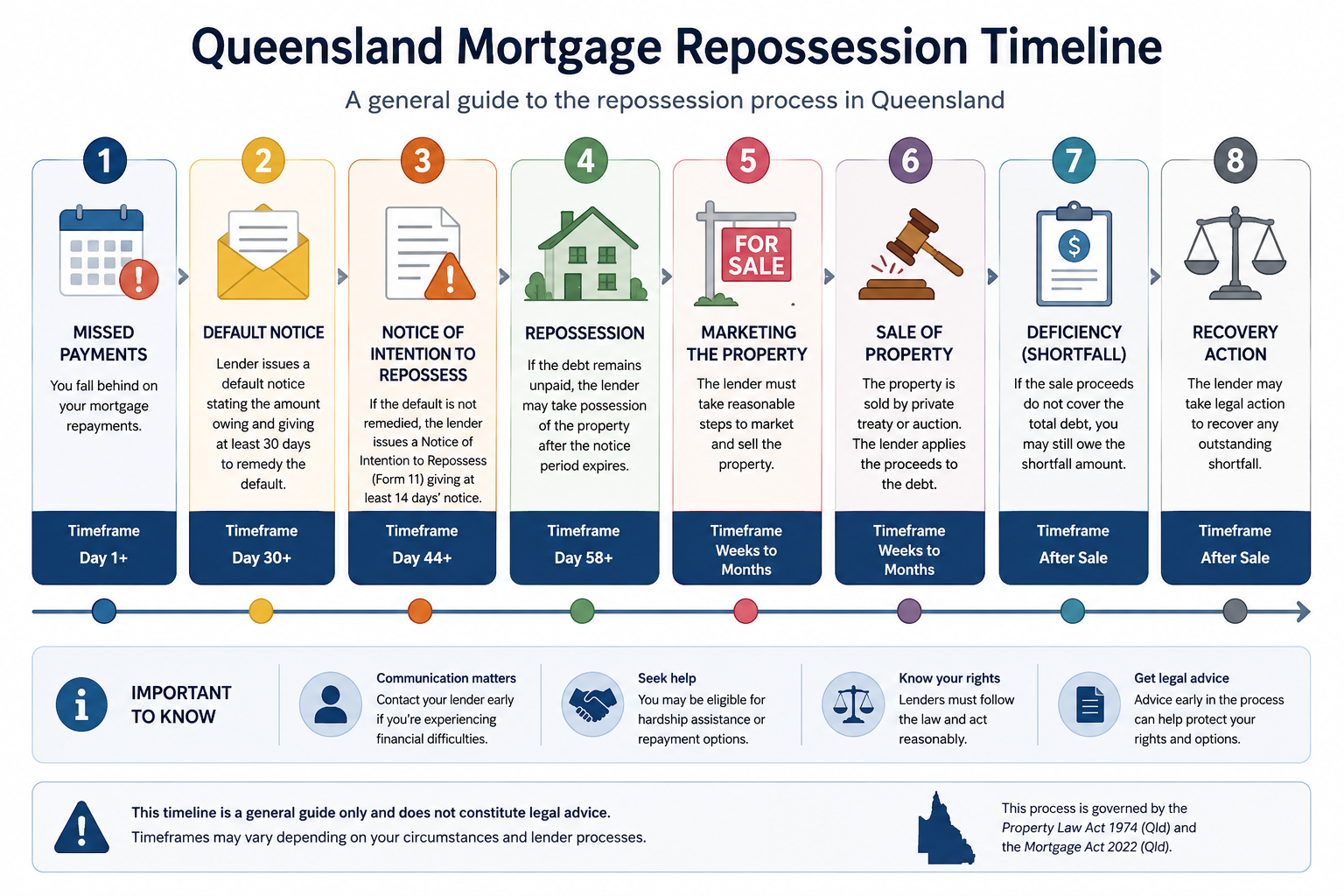
The timeline toward repossession in Queensland typically follows a structured sequence beginning with missed payments and default, followed by issuance of a default notice allowing time to remedy, then escalation to court proceedings if the default is not cured, after which the court may make orders for possession, leading to enforcement through a warrant for possession if the borrower does not vacate, and finally sale of the property by the lender, with the overall timeframe varying depending on borrower engagement, court schedules, and any negotiations or disputes raised, but often spanning several months rather than occurring immediately, meaning borrowers are rarely at risk of instantaneous repossession but must act promptly at each stage to avoid progression.
What Happens After the Bank Starts Court Proceedings?
Once court proceedings are commenced, the lender seeks formal orders for possession of the property and judgment for the outstanding debt, and the borrower must respond within strict timeframes by filing a defence if they wish to contest the claim, as failure to do so may result in default judgment and rapid enforcement, while a properly raised defence may allow the borrower to challenge procedural compliance, assert equitable or statutory grounds, or seek time to resolve the default, however if the court is satisfied that the lender has complied with its obligations and the debt remains unpaid, it will generally grant possession orders, after which the lender can enforce those orders and proceed to sell the property, often with additional legal costs added to the borrower’s debt.
Can Refinancing Help Stop Repossession?
Potentially, yes. Refinancing may help stop repossession where the borrower can repay mortgage arrears, restructure the loan, or obtain more manageable repayment terms before enforcement progresses too far. However, refinancing options often become more limited once default notices or court proceedings have commenced.
Practical Example:
James has accumulated mortgage arrears but still has substantial equity in his property and stable employment. Before possession proceedings advance, he successfully refinances with another lender and uses the new loan to discharge the existing mortgage. Although refinancing does not erase the default history, it prevents the immediate enforcement action and allows him to continue servicing the debt under new arrangements.
Can I Negotiate With the Bank to Stop Repossession?
Yes. Many lenders will consider hardship arrangements, repayment plans, temporary payment reductions, or voluntary sale proposals to stop repossession, particularly where the borrower engages early and provides evidence of financial capacity or changed circumstances.
Does Filing for Bankruptcy Stop Repossession?
Not necessarily. Bankruptcy may affect recovery of unsecured debts, but secured lenders usually retain rights to enforce their mortgage security. In some circumstances, bankruptcy may delay enforcement temporarily, but it does not automatically stop repossession of secured property.
Can the Bank Reject My Hardship Application?
Yes. A lender may reject a hardship request if it considers the proposal unrealistic or unsupported by evidence. However, borrowers seeking to stop repossession should still make hardship applications promptly because delays can significantly worsen enforcement costs and shortfall debt exposure.
Should I Sell the Property Before the Bank Repossesses It?
In some situations, a voluntary sale may help stop repossession proceedings from escalating and may achieve a better sale price than a forced mortgagee sale. This can reduce enforcement costs, preserve equity, and potentially minimise shortfall debt after sale.