


Mortgage Default Notice in Queensland
A mortgage default notice is not just a warning — it is a legally required gateway to enforcement that must comply with the applicable statutory framework and the broader legal principles governing mortgage enforcement.
In Queensland, borrowers may challenge a notice where it is unclear, incorrect, improperly served, or relied upon too early, but not every defect will invalidate enforcement.
The key issue is whether the notice gives a genuine opportunity to remedy the default before the lender acts. Understanding how these rules operate and where defects arise is critical because timing, compliance, and strategy can significantly affect the outcome of any enforcement process.
Why Mortgage Default Notices Matter and Why Validity Is Not Automatic
A mortgage default notice is often the first formal step a lender takes before enforcing its security over property.
In Queensland, that notice is not merely procedural.
It is a legal precondition that must comply with both statutory requirements and the broader principles governing the exercise of a mortgagee’s rights.
Many borrowers assume that once a default notice is issued, enforcement is inevitable.
That assumption is incorrect.
A default notice can be challenged where it fails to meet statutory requirements, misstates the alleged default, is not properly given, or is relied upon prematurely in the enforcement process.
The legal framework governing these notices is layered.
For consumer mortgages, the National Credit Code imposes mandatory notice requirements before enforcement can begin.
Separately, for enforcement steps governed by the Property Law Act 2023 (Qld), which commenced on 1 August 2025 and replaced the Property Law Act 1974 (Qld), Queensland law regulates the exercise of a mortgagee’s power of sale and requires a notice identifying the default and allowing time to remedy it.
These regimes can operate together, and a failure to comply with either may affect the lender’s ability to enforce.
The significance of compliance reflects the broader duties imposed on mortgagees when exercising their rights.
Even where a borrower is in default, the law does not permit a lender to act without regard to the borrower’s legal and equitable interests.
The High Court has long emphasised that the exercise of mortgage powers is constrained by obligations of good faith. The High Court observed at [481]:
… if a mortgagee in exercising his power of sale exercises it in good faith, without any intention of dealing unfairly by his mortgagor, it would be very difficult indeed, if not impossible, to establish that he had been guilty of any breach of duty towards the mortgagor. Of course, if he wilfully and recklessly deals with the property in such a manner that the interests of the mortgagor are sacrificed, I should say that he had not been exercising his power of sale in good faith.
That principle remains central.
A mortgagee is entitled to protect its own interests, but it must do so within the boundaries set by statute and the general law.
A defective or premature default notice does not automatically extinguish the mortgage or the underlying debt.
However, it can disrupt or invalidate particular enforcement steps, including possession proceedings or the exercise of a power of sale.
In some cases, it may require the lender to restart the enforcement process with a compliant notice.
Understanding how and why a default notice can be challenged, therefore, requires close attention to both statutory compliance and the underlying legal principles governing mortgage enforcement.
In this article, our Queensland commercial litigation lawyers explain in a lot more detail.
What is a mortgage default notice in Queensland?
A mortgage default notice is a formal legal notice issued by a lender to a borrower after a breach of the loan or mortgage has occurred.
It is not simply a warning.
It is a mandatory legal step that must usually occur before a lender can enforce its security.
In Queensland, a default notice operates within two overlapping legal frameworks.
These are the National Consumer Credit Protection Act 2009 (Cth) (the NCCP Act), including the National Credit Code in Schedule 1 (the Code), and the Property Law Act 2023 (Qld) (the PLA).
Understanding both regimes is critical because a notice may need to comply with one or both.
The two notice regimes that often apply together
For most residential home loans, the National Credit Code applies.
Section 88 of the Code requires a credit provider to give a default notice before beginning enforcement proceedings.
That notice must identify the default and give the borrower at least 30 days to remedy it.
If the default is remedied within the notice period, the contract or mortgage is reinstated, and any acceleration clause cannot operate in respect of that default.
Separately, Queensland property law regulates the exercise of a mortgagee’s power of sale.
Under section 114 of the Property Law Act 2023 (Qld), a mortgagee must not exercise the power of sale unless:
- a default has occurred
- a notice stating the nature of the default has been given
- the default has not been remedied within at least 30 days
These requirements are independent of the Code.
This means a lender may need to comply with both regimes simultaneously.
The Code itself recognises this overlap.
It provides that its notice requirements operate in addition to other laws relating to mortgages.
In practice, lenders often issue a combined default notice intended to satisfy both the Code and the Property Law Act.
Why one document may need to satisfy more than one law
A key issue in challenging a default notice is whether it properly satisfies each applicable legal regime.
A notice may appear compliant on its face but fail under one framework.
For example, a notice might:
- identify a default, but not do so with sufficient clarity
- give a timeframe, but misstate when that period begins
- comply with the Code, but not satisfy the requirements for exercising a power of sale under Queensland law
This creates a layered compliance problem.
A lender cannot safely rely on partial compliance where statutory preconditions to enforcement have not been satisfied.
If enforcement is later based on a defective notice, that defect may undermine the validity of subsequent steps.
This reflects the broader principle that mortgage enforcement is not purely contractual, but is constrained by statutory requirements and equitable obligations.
It is constrained by statutory requirements and equitable obligations.
The High Court has made clear that the exercise of mortgagee powers is not unfettered.
A mortgagee must act in good faith and cannot disregard the mortgagor’s interests.
This principle informs how default notices are assessed.
A notice is not merely a technical formality.
It is part of a structured legal process that gives the borrower a genuine opportunity to remedy the default before enforcement.
The practical role of a default notice in enforcement
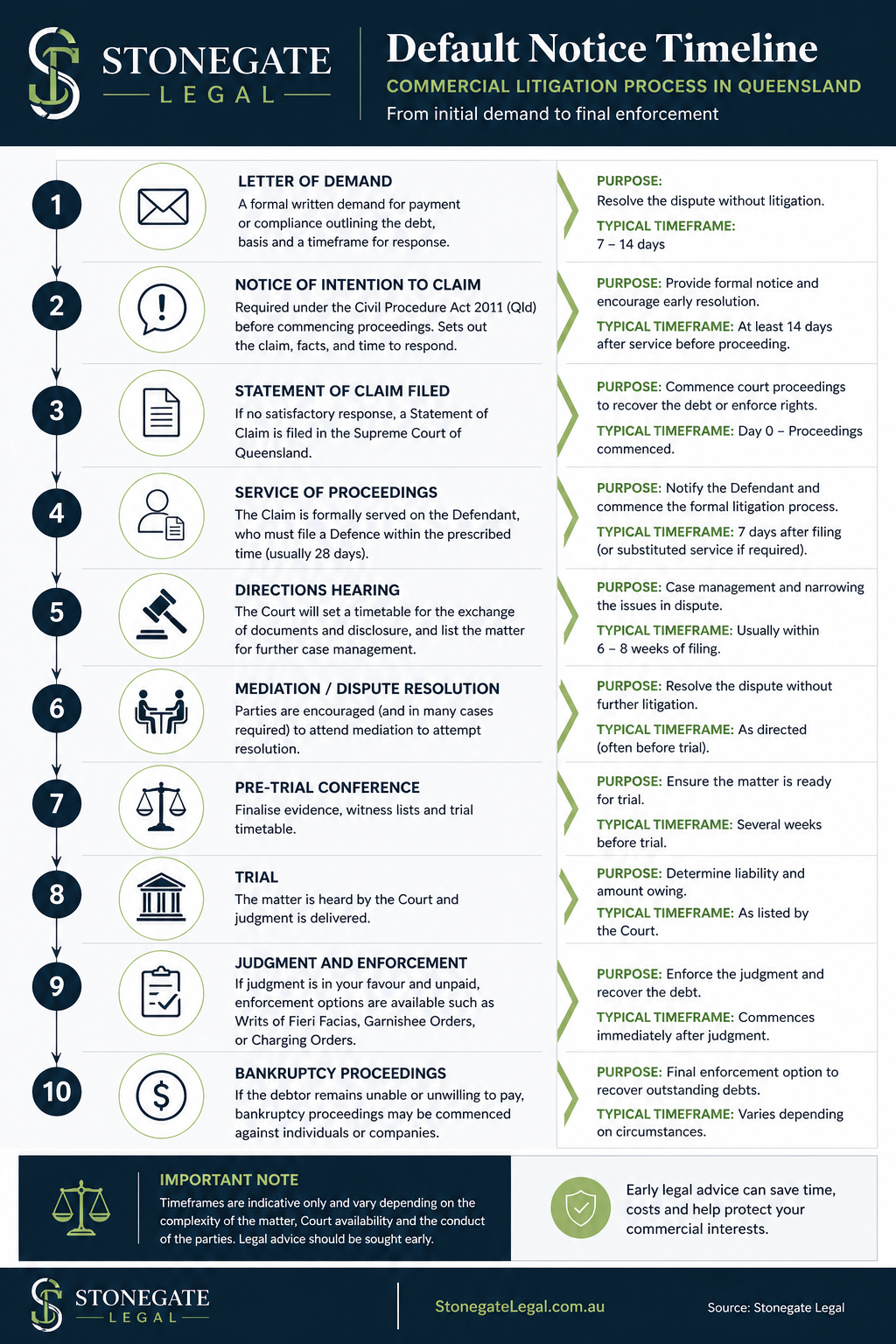
A default notice performs several legal functions.
- It formally identifies the alleged breach.
- It gives the borrower a defined opportunity to fix that breach.
- It acts as a gateway to enforcement.
Without a valid notice, a lender’s ability to proceed to possession or sale may be delayed or challenged.
This does not mean that every defect will invalidate enforcement entirely.
However, it does mean that compliance with notice requirements is a critical threshold issue.
That is why challenges to default notices often focus on:
- whether the notice clearly identifies the default
- whether the time to remedy has been properly given
- whether the notice was properly issued or received
- whether the lender has complied with all applicable statutory requirements
These issues go directly to whether the lender has lawfully activated its enforcement rights.
The next section examines when and how those issues arise in practice.
When can a mortgage default notice be challenged?
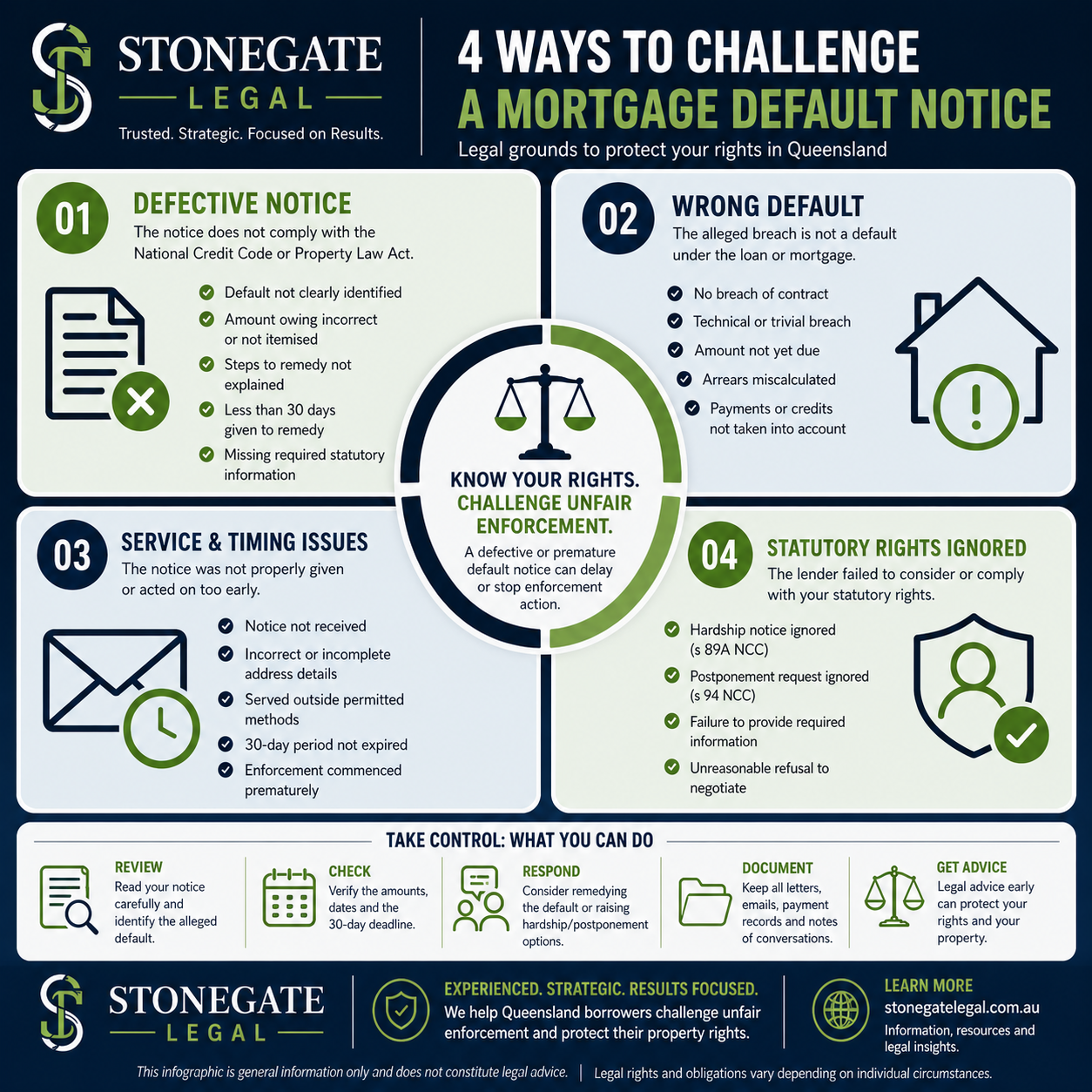
A mortgage default notice can be challenged if it fails to comply with the legal requirements governing mortgage enforcement.
This is not limited to obvious errors.
Challenges often arise from technical, procedural, or evidentiary defects that go to whether enforcement has been lawfully triggered.
In Queensland, these challenges usually fall into four broad categories.
Each reflects a different way in which the notice, or the steps surrounding it, may fail to meet statutory or legal standards.
Example: Incorrect arrears and premature enforcement
A borrower receives a default notice stating they are $18,500 in arrears. However, the lender has failed to credit two recent payments. The borrower is in fact only $6,200 behind.
The notice also states that enforcement will begin 30 days from the date of the letter, but the lender files possession proceedings 25 days after posting it.
In this scenario, the borrower may challenge the notice on multiple grounds, including incorrect identification of the default, misstatement of the amount owing, and premature enforcement. Even if the mortgage itself remains valid, the enforcement step may be set aside or delayed until a compliant notice is issued.
The notice is legally defective on its face
The first category concerns defects within the notice itself.
A valid notice must clearly identify the default and what is required to remedy it.
Under section 88 of the National Credit Code, which is Schedule 1 to the National Consumer Credit Protection Act 2009 (Cth), a credit provider generally must give a compliant default notice allowing at least 30 days from the date of the notice to remedy the default before enforcement can begin.
A Code default notice must also contain a prominent default notice heading and specify the default, the action necessary to remedy it, the remedy period, the date after which enforcement may begin, prescribed information about hardship and postponement rights, and information about AFCA rights.
Under section 114 of the Property Law Act 2023 (Qld), a notice must state the nature of the default and require that it be remedied within at least 30 days before a power of sale can be exercised.
A notice that fails to meet these requirements may be open to challenge.
Common issues include:
- unclear or ambiguous description of the default
- incorrect calculation of arrears or amounts said to be due
- failure to specify what must be done to remedy the breach
- omission or misstatement of the time allowed to remedy
These are not merely technical concerns.
They then determine whether the borrower has been given a genuine opportunity to understand and respond to the alleged default.
A defective default notice may affect whether enforcement can lawfully proceed, but borrowers should also consider what happens if the matter progresses further. We have explained mortgage sale debt and liability after repossession, including shortfall debt, post-sale demands, and ongoing borrower exposure.
The alleged default is wrong, overstated or not properly particularised
A notice may also be challenged where the underlying default is disputed.
This includes situations where:
- the borrower has already remedied the default
- payments have been misapplied or not properly credited
- fees or interest have been incorrectly calculated
- the lender relies on a breach that is not clearly identified or supported
In these cases, the issue is not just the form of the notice, but its substance.
The law does not permit a lender to rely on a notice that misstates the true position between the parties.
This reflects the broader obligation on a mortgagee to act within the limits of its legal rights when enforcing its security.
The High Court has recognised that while a mortgagee may act in its own interests, it must not act in a way that improperly prejudices the mortgagor. In Australia and New Zealand Banking Group Ltd v Bangadilly Pastoral Co Pty Ltd (1978) 139 CLR 195, Jacobs J said at [202]:
The power of sale is conferred upon the mortgagee for his own benefit. It is given to him to enable him to obtain repayment of the money owing to him. It is not a power which he is bound to exercise for the benefit of the mortgagor.
Although that principle arises in the context of sale, it reflects the broader requirement that enforcement steps must be grounded in a lawful and accurate basis.
The notice was not properly given or the timing is defective
A further category of challenge concerns how and when the notice was given.
Both the Code and the PLA depend on the passage of time after the notice is given.
If the notice is not properly served or the timeframe is incorrectly calculated, enforcement may be premature.
Issues commonly arise where:
- the borrower did not receive the notice
- the lender cannot prove when or how the notice was given
- the 30-day period has been incorrectly calculated
- enforcement steps are taken before the expiry of the statutory period
These matters are often fact-specific.
They depend on the evidence of service, the terms of the mortgage, and the applicable statutory requirements.
In Queensland, disputes over timing can also arise when a lender takes preparatory steps toward a sale before the notice period has expired.
The courts have recognised that the timing and structure of enforcement steps must be carefully assessed.
Whether those steps are permissible depends on how they interact with the statutory requirements governing the exercise of the power of sale.
Enforcement is premature due to hardship or statutory rights
A default notice may also be challenged where the lender has failed to comply with statutory protections available to borrowers.
Under the Code, borrowers may request hardship variations or seek to negotiate the postponement of enforcement.
These rights operate within a structured statutory framework.
If properly invoked, they can affect whether and when enforcement may proceed.
For example:
- where section 89A applies, a hardship notice can prevent enforcement from beginning until the credit provider has responded and a further 14 days has expired after giving a notice that no agreement has been reached.
- a postponement request under section 94 must be responded to within 21 days, and enforcement generally cannot begin until the credit provider has responded and a further 14 days has expired.
- failure to comply with these requirements may delay or undermine enforcement steps.
These issues are often overlooked in practice.
However, they can be critical in determining whether a lender has lawfully progressed beyond the default notice stage.
Why these categories matter
These four categories are not mutually exclusive.
In many cases, multiple issues arise at the same time.
A notice may be defective in form, based on an incorrect default, improperly served, and relied upon prematurely.
Each issue affects whether the lender has validly engaged the enforcement process.
A mortgage default notice is not simply a procedural step. It is a legal threshold.
If that threshold is not properly met, the steps that follow may be open to challenge.
The next section examines the specific legal grounds for challenge in detail.
When is a mortgage default notice invalid in Queensland?
This section addresses the specific legal grounds upon which a mortgage default notice may be challenged.
Below is a table summarising the main features that may render a mortgage default notice invalid.
| Requirement | What the Law Requires | Why It Matters | Risk if Missing |
| Clear identification of default | Must state the nature of the breach | Borrower must understand the issue | Notice may be unclear or ineffective |
| Amount owing | Must specify arrears or obligation | Allows borrower to verify and remedy | Default may be disputed |
| How to remedy | Must explain what borrower must do | Enables compliance within timeframe | Notice may fail its purpose |
| Minimum 30 days | Must allow at least 30 days to fix | Statutory protection under NCCP Act and PLA | Enforcement may be premature |
| Proper service | Must be “given” in accordance with law | Starts the remedy period | Timing may be invalid |
| Compliance with both regimes | Must satisfy Code and PLA (if applicable) | Dual compliance often required | Partial compliance may fail |
These grounds are rooted in statutory compliance, contractual accuracy, and the broader principles governing the exercise of mortgagee rights.
Each ground should be analysed separately, but in practice, they often overlap.
The notice does not properly identify the default
A valid default notice must clearly identify the nature of the default and what is required to remedy it.
Under the PLA, a mortgagee must give a notice stating the nature of the default and requiring it to be remedied within at least 30 days before exercising the power of sale.
Under the NCCP Act, including the Code, the notice must also identify the default and allow at least 30 days to remedy it before enforcement can begin.
A failure to properly articulate the default may render the notice ineffective.
This includes situations where the notice:
- does not clearly identify the obligation said to be breached
- aggregates multiple defaults without explanation
- states an amount owing without showing how it is calculated
- fails to specify what must be done to remedy the breach
These defects are substantive. They go on to determine whether the borrower has been given a meaningful opportunity to understand and respond to the alleged breach.
The courts have consistently emphasised that the exercise of mortgagee powers must be grounded in proper and lawful conduct. The High Court has long treated the mortgagee’s power of sale as constrained by good faith. In Forsyth v Blundell [1973] HCA 20; (1973) 129 CLR 477 at [481], Menzies J, adopting Lord Herschell’s formulation, said:
… if a mortgagee in exercising his power of sale exercises it in good faith, without any intention of dealing unfairly by his mortgagor, it would be very difficult indeed, if not impossible, to establish that he had been guilty of any breach of duty towards the mortgagor. … Of course, if he wilfully and recklessly deals with the property in such a manner that the interests of the mortgagor are sacrificed, I should say that he had not been exercising his power of sale in good faith.
A notice that obscures the true nature of the default may undermine that requirement.
The lender has not allowed the required time to remedy
A default notice must give the borrower a minimum statutory period to remedy the default. It must identify the nature of the default and what the borrower must do to remedy it.
The notice should clearly identify the alleged default and the steps required to remedy it. If it does not, the borrower may argue that the notice failed to perform its statutory function.
Under both the Code and the PLA, the minimum statutory period is at least 30 days.
Errors in calculating or applying this period are a common challenge.
Issues arise where:
- the notice specifies an incorrect deadline
- the period is calculated from the wrong starting point
- enforcement steps are taken before the period expires
These issues are not merely procedural.
They affect whether the lender has lawfully engaged its enforcement rights.
The statutory requirement for a cure period reflects the principle that borrowers must be given a real opportunity to remedy default before enforcement.
Where that opportunity is not properly provided, the validity of subsequent enforcement steps may be questioned.
The notice was not properly given or cannot be proven
A further ground of challenge concerns the giving of the notice.
Both the Code and the PLA require that the notice be “given” to the borrower.
This raises questions of service and proof.
A lender must be able to establish:
- how the notice was sent
- when it was sent
- that it was given in accordance with the applicable contractual and statutory requirements
Disputes often arise where the borrower denies receiving the notice or where the evidence of service is unclear.
These issues are fact-dependent.
However, they can be critical because the statutory time period runs from when the notice is given.
If the lender cannot establish that the notice was properly given, the validity of the enforcement process may be undermined.
The alleged default is incorrect, overstated or already remedied
A notice may also be challenged if the underlying default is inaccurate.
This includes situations where:
- the borrower has already remedied the default
- payments have been incorrectly recorded or allocated
- the amount claimed includes fees or charges that are not properly due
- the default is based on a misunderstanding of the loan terms
Under the Code, if the default is remedied within the notice period, the contract or mortgage is reinstated and acceleration cannot operate in respect of that default.
This makes the accuracy of the alleged default a central issue.
A notice based on an incorrect or overstated default may therefore be open to challenge.
The broader principles governing mortgage enforcement reinforce this position.
A mortgagee is entitled to act in its own interests but must do so within the limits of its legal rights.
To take enforcement steps based on an incorrect default risks exceeding those limits.
The lender has failed to comply with hardship or postponement obligations
The National Credit Code provides borrowers with statutory rights that can affect enforcement.
These include the ability to request a hardship variation or to seek postponement of enforcement.
Where these rights are properly invoked, they impose obligations on the lender.
For example:
- where section 89A applies, a hardship notice may prevent enforcement from beginning until the credit provider has responded and any applicable statutory period has expired.
- failure to comply with these obligations may delay or invalidate enforcement steps.
These provisions recognise that default may arise from temporary financial difficulty.
They are designed to ensure that enforcement does not proceed without proper consideration of the borrower’s position.
A failure to comply with these requirements may provide a basis to challenge reliance on a default notice.
The notice is relied upon in a way that is inconsistent with the mortgagee’s duties
Even where a notice is formally valid, the way in which it is relied upon may be challenged.
This arises where the lender’s conduct in enforcing the mortgage is inconsistent with its legal obligations.
The High Court has emphasised that a mortgagee must act in good faith and is not free to exercise its powers in a manner that improperly disadvantages the mortgagor. In Australia and New Zealand Banking Group Ltd v Bangadilly Pastoral Co Pty Ltd (1978) 139 CLR 195, the High Court said at [202]:
The power of sale is conferred upon the mortgagee for his own benefit. It is given to him to enable him to obtain repayment of the money owing to him. It is not a power which he is bound to exercise for the benefit of the mortgagor.
This principle is most often applied in the context of sales.
However, it reflects a broader constraint on the exercise of mortgagee powers.
If a default notice is used as part of a process that disregards those obligations, that conduct may be open to challenge.
The interaction of multiple defects
In practice, challenges rarely depend on a single issue. A notice may suffer from multiple defects at once.
For example, it may:
- misstate the default
- provide an incorrect timeframe
- be improperly served
- be relied upon prematurely
Each of these matters reinforces the others.
Together, they may significantly undermine the validity of the enforcement process.
A mortgage default notice is therefore not a mere formality.
It is a legally significant step that must comply with strict requirements.
If those requirements are not met, the notice and the enforcement steps that follow may be open to challenge.
What the court will look at
Courts do not assess a mortgage default notice in the abstract.
They focus on whether the lender has complied with the legal preconditions to enforcement, and whether the process has been carried out in accordance with statute and the general law.
The analysis is practical, evidence-based, and closely tied to the relief being sought.
The focus is usually on compliance, evidence and substance.
The starting point is statutory compliance.
The court will examine whether the notice satisfies the requirements of the NCCP Act, and the PLA, where applicable.
This includes:
- whether the notice identifies the default with sufficient clarity
- whether it specifies what must be done to remedy the default
- whether it provides at least the required 30 day period
- whether it complies with any prescribed form or content requirements
The court will then consider evidence of service. This is often critical.
The lender must be able to establish when and how the notice was given.
If service is disputed or unclear, the court may not be satisfied that the statutory time period has properly commenced.
The court will also assess the accuracy of the alleged default.
This includes:
- whether the borrower was in default at the time the notice was issued
- whether the amount claimed is correct
- whether the default had already been remedied
- whether the lender has correctly applied payments and charges
These issues go directly to whether the notice accurately reflects the parties’ true legal position.
The court examines the purpose and effect of the notice
A default notice is not assessed purely as a formal document.
The court considers whether it has performed its legal function.
That function is to give the borrower a genuine opportunity to understand the breach and remedy it within the statutory period.
If a notice is unclear, misleading, or incomplete, the court may find that it has not fulfilled that purpose.
This reflects the broader principle that enforcement powers must be exercised within legal limits.
The High Court has emphasised that a mortgagee’s conduct must be assessed by reference to its obligations in exercising its powers. In Forsyth v Blundell (1973) 129 CLR 477, the High Court said at [481]:
If he wilfully and recklessly deals with the property in such a manner that the interests of the mortgagor are sacrificed, I should say that he had not been exercising his power of sale in good faith.
Although this principle arises in the context of sale, it informs how courts approach earlier steps in the enforcement process.
An invalid notice does not always end the dispute
A key point is that an invalid default notice does not necessarily determine the entire dispute.
The court’s focus is usually narrower.
It asks whether the lender has validly taken the step it seeks to rely on.
If the notice is defective, the consequences may include:
- refusal of possession or enforcement orders
- an injunction restraining further steps
- a requirement that a fresh, compliant notice be issued
In some cases, the lender may be able to correct the defect and recommence the process.
This reflects the fact that the mortgage itself remains in place.
However, defects in the notice can significantly delay enforcement and affect the validity of subsequent steps.
The nature of the relief sought is critical
The court’s analysis is also shaped by the relief being sought.
For example:
- in possession proceedings, the court will focus on whether the lender has satisfied the preconditions to enforcement
- in an application for injunctive relief, the court will consider whether there is a serious question to be tried and whether damages would be an adequate remedy
- in disputes about sale, the court may consider whether the power of sale has been properly exercised
This context matters.
The same defect may have different consequences depending on the procedural setting.
The court does not require perfection, but it requires compliance
Courts do not approach default notices with an expectation of technical perfection.
However, they do require compliance with statutory requirements and the essential elements of the notice.
Minor errors may not always be decisive.
But where defects affect the substance of the notice, or the borrower’s ability to respond, they may be sufficient to undermine enforcement.
This reflects the balance at the heart of mortgage law.
A lender is entitled to enforce its security.
But it must do so within the legal framework that governs how and when those rights can be exercised.
Practical signs that a mortgage default notice may be defective
In practice, borrowers and their advisers rarely begin with abstract legal principles.
The starting point is usually the document itself.
Certain recurring features may indicate that a default notice does not comply with the NCCP and the PLA requirements.
These indicators are not determinative on their own.
However, they often signal issues that warrant closer legal analysis. The table below illustrates common defects in mortgage default notices.
| Issue Identified | What It Looks Like in Practice | Legal Significance | Can It Be Challenged? |
| Vague default | “You are in default” with no detail | Fails to identify breach clearly | Yes |
| Incorrect amount | Arrears appear inflated or unexplained | May misstate default | Yes |
| No clear remedy steps | No instructions on how to fix default | Borrower cannot comply | Yes |
| Less than 30 days | Shortened or unclear timeframe | Breach of statutory requirement | Yes |
| Service issues | Borrower never received notice | Time may not have started | Yes |
| Mixed legal frameworks | Generic notice attempting dual compliance | May fail one regime | Yes |
Quick checklist: Is your default notice defective?
You may have grounds to challenge the notice if:
- the default is unclear or not properly explained
- the amount claimed cannot be verified
- the notice does not explain how to fix the breach
- less than 30 days has been given to remedy
- you never received the notice
- enforcement started before the deadline expired
- hardship or postponement rights were ignored
The amount claimed is unclear or appears incorrect
A common issue is a lack of transparency in how the alleged default is calculated.
This may include:
- a single lump sum with no breakdown
- unexplained fees, interest or charges
- inconsistencies between the account statements and the notice
A borrower must be able to understand what is said to be owed and why.
If the amount cannot be readily verified, the notice may not properly identify the default.
This is not merely an accounting issue.
It goes to whether the notice provides a meaningful opportunity to remedy the alleged breach.
The default is described in vague or generic terms
A valid notice should clearly identify the nature of the breach.
Problems arise where the notice:
- refers broadly to being “in default” without explanation
- lists multiple potential breaches without specifying which applies
- uses generic language not tailored to the borrower’s circumstances
A borrower cannot remedy a default that is not properly identified.
This kind of ambiguity may undermine the effectiveness of the notice.
The requirement for clarity reflects the broader obligation that a mortgagee must not act in a way that disregards the mortgagor’s interests.
The notice does not clearly explain how to remedy the default
A default notice must do more than identify a problem.
It must explain what the borrower needs to do to fix it.
Warning signs include:
- no clear instructions on payment or corrective action
- failure to specify a required amount or deadline
- contradictory or confusing directions
If the notice does not provide a clear path to remedy, it may fail to perform its statutory function.
The timeframe to remedy is unclear or incorrectly stated
Both the National Credit Code and the Property Law Act require that the borrower be given at least 30 days to remedy the default, although the starting point for that period depends on the applicable statutory framework.
Issues arise where:
- the deadline is unclear or expressed inconsistently
- the timeframe appears shorter than required
- the starting point for the period is ambiguous
Even small errors in timing can be significant.
The statutory period is a core protection.
It ensures that enforcement does not occur without a genuine opportunity to remedy the breach.
There is uncertainty about when or how the notice was given
Questions about service are common.
A notice may be open to challenge where:
- the borrower does not recall receiving it
- it was sent to an incorrect or outdated address
- there is no clear evidence of when it was given
These issues are important because the remedy period runs from when the notice is given.
If that cannot be established, the timing of enforcement may be affected.
The notice appears to rely on multiple legal regimes without clearly satisfying any
Many default notices are drafted to comply with both the National Credit Code and Queensland Property Law.
However, problems arise where the notice:
- attempts to satisfy both regimes in a single document
- uses generic or templated language
- fails to address the specific requirements of each framework
This can result in a notice that appears comprehensive but is legally incomplete.
A failure under either regime may be sufficient to affect enforcement.
The notice is followed by immediate or premature enforcement steps
A further practical indicator is the lender’s conduct after issuing the notice.
Concerns arise where:
- enforcement action is threatened immediately
- possession proceedings are commenced before the expiry of the notice period
- steps toward sale are taken without regard to statutory timing requirements
These actions may suggest that the notice is being relied upon inconsistently with the governing legal framework.
The courts have recognised that the exercise of mortgagee powers must be assessed in context.
In some circumstances, preparatory steps toward sale may be taken before the expiry of a notice period, but the validity of those steps depends on how they interact with statutory requirements.
The critical issue is whether the power of sale is exercised lawfully.
This reflects the broader principle that enforcement must be grounded in legal compliance, not assumption.
Why these practical signs matter
These indicators are not conclusive on their own.
A notice may contain one or more of these features and still be valid.
However, they often point to underlying legal issues.
A mortgage default notice is a gateway step.
If it is defective, the enforcement process that follows may be open to challenge.
For that reason, careful scrutiny of the notice itself is often the first step in assessing whether enforcement has been lawfully initiated.
| Feature | Valid Default Notice | Potentially Defective Notice |
| Default description | Clear and specific | Vague or generic |
| Amount owing | Itemised and accurate | Lump sum or incorrect |
| Remedy steps | Clearly explained | Missing or unclear |
| Timeframe | At least 30 days | Shortened or ambiguous |
| Service | Proven and compliant | Uncertain or disputed |
| Enforcement timing | After expiry | Premature |
Common misconceptions about challenging a default notice
Misunderstandings about mortgage default notices are common.
These misconceptions can affect how borrowers respond and how enforcement unfolds.
Clarifying them is important because the legal position is often more nuanced than it first appears.
“Any mistake makes the notice invalid”
Not every error will invalidate a default notice.
Courts distinguish between minor defects and substantive non-compliance.
A notice that contains a small clerical error may still be effective.
However, where the defect affects the borrower’s ability to understand the default or remedy it, the position is different.
The law focuses on whether the notice has performed its legal function.
That function is to clearly identify the default and provide a genuine opportunity to fix it.
If that function is undermined, the notice may be open to challenge.
“Once a default notice is issued, repossession is inevitable”
A default notice is a preliminary step.
It does not, of itself, entitle the lender to take possession or sell the property.
Under the NCCP, the Code and the PLA, enforcement generally cannot proceed until:
- a compliant notice has been given
- the required time to remedy has passed
- the default has not been remedied
Until those conditions are met, enforcement rights are not fully engaged.
Even after that point, enforcement may still be challenged on legal or procedural grounds.
“If the notice is invalid, the mortgage is unenforceable”
This is incorrect.
An invalid default notice does not extinguish the mortgage or the underlying debt.
The lender’s security remains in place.
What is affected is the particular enforcement step taken in reliance on that notice.
In many cases, the consequence of a defective notice is that:
- enforcement is delayed
- a fresh notice must be issued
- the process must restart in a compliant way
This reflects the distinction between the existence of the mortgage and the lawful exercise of enforcement powers.
“Hardship requests automatically stop enforcement”
The National Credit Code provides mechanisms for borrowers to seek hardship variations or postponement.
However, these rights operate within a structured framework.
A hardship notice does not automatically prevent enforcement indefinitely.
The lender must respond in accordance with the statutory requirements.
Depending on the response, enforcement may be delayed, varied, or allowed to proceed.
The effect of hardship depends on compliance with that framework, not simply the fact that a request has been made.
“The bank must act in the borrower’s best interests”
A mortgagee is not required to act in the borrower’s best interests.
It is entitled to act in its own commercial interests.
However, it must do so within legal limits.
This does not impose a fiduciary duty.
But it does constrain how enforcement powers can be exercised.
“You can always unwind a sale if the notice was defective”
This is a common but incorrect assumption.
Once a property has been sold to a third party, the position becomes more complex.
Under Queensland property law, a purchaser is generally protected and is not required to investigate whether the power of sale was properly exercised.
This means that even if there was a defect in the notice or the process, the borrower’s remedy may be limited.
In many cases, the remedy lies against the mortgagee, not the purchaser.
The court’s focus shifts from undoing the sale to addressing whether the mortgagee has breached its obligations.
Why these misconceptions matter
These misconceptions can lead to poor decision-making.
For example:
- assuming that a minor defect will automatically defeat enforcement
- ignoring a notice on the basis that it is thought to be invalid
- relying on hardship without understanding the statutory process
Each of these approaches carries risk.
A mortgage default notice sits at a critical point in the enforcement process.
Understanding what it does, and what it does not do, is essential to assessing whether and how it can be challenged.
Consequences of ignoring a defective or non-defective default notice
Whether a default notice is valid or defective, ignoring it carries significant legal and practical consequences.
The risks differ depending on the validity of the notice, but in both cases, inaction can materially affect the borrower’s position.
Mortgage Default Notice Timeline (Queensland)
See the figure below for a visual overview of the enforcement process from default notice to sale.
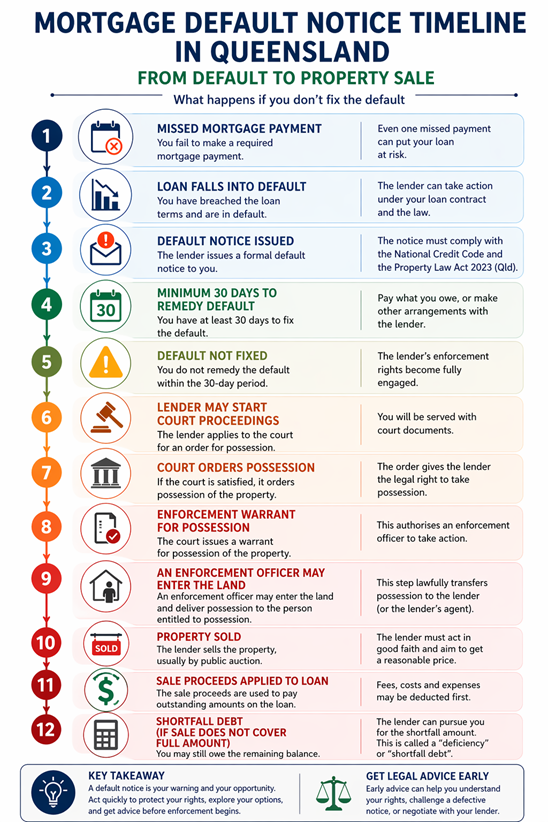
Figure 1: Mortgage default notice timeline in Queensland.
Ignoring a valid default notice
If a default notice is valid and the borrower does not respond within the required timeframe, the lender’s enforcement rights become fully engaged.
Under the National Consumer Credit Protection Act 2009 (Cth), including the National Credit Code, and the Property Law Act 2023 (Qld), this typically allows the lender to proceed to enforcement.
This may include:
- commencing possession proceedings
- seeking judgment for the debt
- exercising the power of sale
Once the remedy period expires without compliance, the borrower loses the statutory opportunity to reinstate the loan by remedying the default.
At that point, enforcement is no longer contingent on further notice.
The lender is entitled to act, subject to compliance with the broader legal framework.
The High Court has recognised that a mortgagee is entitled to realise its security, provided it does so within the limits of its legal rights. In Australia and New Zealand Banking Group Ltd v Bangadilly Pastoral Co Pty Ltd (1978) 139 CLR 195, the High Court observed at [202]:
It is concerned with a genuine primary desire to obtain for the mortgaged property the best price obtainable consistently with the right of a mortgagee to realize his security.
Ignoring a valid notice, therefore, exposes the borrower to the full consequences of enforcement.
Ignoring a defective default notice
A defective notice may provide grounds to challenge enforcement.
However, ignoring it entirely can still be risky.
A borrower who takes no action may face:
- enforcement steps based on the lender’s assumption of validity
- possession proceedings that must be defended after they are commenced
- increased costs and procedural complexity
Even where a notice is defective, the lender may proceed on the basis that it is valid.
The burden may then fall on the borrower to raise the defect in response to enforcement action.
In some cases, the lender may also issue a fresh, compliant notice, restarting the process.
This can reduce the practical advantage of the defect if it is not identified and addressed early.
Delay may reduce available options
Timing is critical. A default notice creates a defined period within which certain rights can be exercised.
These may include:
- remedying the default
- negotiating with the lender
- invoking hardship provisions under the National Credit Code
- seeking to challenge the notice before enforcement escalates
If this period is allowed to pass without action, those options may become more limited.
For example:
- the statutory right to reinstate the contract by remedying default is tied to the notice period
- hardship requests may be less effective once enforcement has progressed
- court proceedings introduce additional procedural and cost considerations
Delay does not eliminate all rights, but it can narrow the available pathways.
The position becomes more complex once enforcement begins
Once enforcement steps are underway, the legal landscape changes.
The dispute may shift from the validity of the notice to the validity of the enforcement process as a whole.
This may involve:
- defending possession proceedings
- seeking injunctive relief
- challenging the exercise of the power of sale
At this stage, the borrower’s position is often more constrained.
Procedural timelines apply, and the focus may move from preventing enforcement to responding to it.
Sale to a third party may limit remedies
If the property is sold, the consequences can be more difficult to reverse.
Under Queensland property law, a purchaser is generally protected and is not required to investigate whether the power of sale has been properly exercised.
This means that even if the default notice was defective, the sale itself may remain effective.
The borrower’s remedy may instead lie against the mortgagee.
The courts have recognised that the primary obligation of a mortgagee in exercising the power of sale is directed to how that power is exercised, rather than undoing completed transactions.
This shifts the focus from preventing the sale to assessing whether the mortgagee has complied with its obligations.
Why inaction carries risk in both scenarios
Whether a notice is valid or defective, ignoring it removes control over the process.
In a valid notice scenario, it allows enforcement to proceed unchallenged.
In a defective notice scenario, it may delay the identification of issues until enforcement is already underway.
A mortgage default notice is a critical point in the enforcement timeline.
Engagement with that process, rather than inaction, is often central to preserving legal and practical options.
Queensland-specific and unsettled issues to note
Mortgage default notices in Queensland operate within a legal framework that is not entirely uniform.
There are areas where the law is clear, and others where the interaction between statutory regimes, contractual terms, and common law principles remains unsettled or highly fact-specific.
These issues are important because they can affect how a notice is assessed and how enforcement proceeds.
National Credit Code and the Property Law Act 2023 (Qld)
One of the most significant Queensland-specific issues is the interaction between the National Consumer Credit Protection Act 2009 (Cth), including the National Credit Code, and the Property Law Act 2023 (Qld).
The interaction between the National Credit Code and Queensland property legislation is important because section 88 of the Code expressly provides that its notice requirements operate in addition to other laws relating to the enforcement of real property mortgages.
However, they arise from different sources and serve different purposes.
The Code regulates consumer credit contracts and imposes mandatory notice requirements before enforcement.
The PLA governs the exercise of proprietary rights, including the power of sale.
In practice, lenders often issue a single notice intended to satisfy both regimes.
The difficulty is that the requirements are not identical.
A notice may comply with the Code but fail to satisfy the PLA, or vice versa.
The extent to which a single notice can validly satisfy both regimes depends on its content and the circumstances in which it is given.
This is an area where outcomes are often fact-specific.
The threshold for sufficient particularity in identifying default
The law requires that a default notice identify the nature of the default.
However, the level of detail required is not always clear.
Some notices provide detailed breakdowns of arrears and contractual breaches.
Others adopt more general language.
The question of sufficiency often turns on whether the borrower has been given a meaningful opportunity to understand and remedy the default.
This is not always a binary issue.
It may depend on:
- the complexity of the loan arrangement
- the nature of the alleged breach
- the information already available to the borrower
Courts approach this issue contextually rather than mechanically.
Proof of service and evidentiary challenges
Service of a default notice is frequently contested.
The relevant statutes require that the notice be given, but do not always prescribe a single method of service.
As a result, disputes can arise about:
- whether the notice was actually received
- whether it was sent in accordance with the mortgage terms
- whether the lender can prove when it was given
These issues are highly evidentiary.
They depend on the available records and the credibility of competing accounts.
The courts have recognised that enforcement rights depend on compliance with these preliminary steps.
The sufficiency of a default notice will usually depend on whether the notice identifies the alleged default and the steps required to remedy it with enough clarity to give the borrower a proper opportunity to respond.
The case illustrates that enforcement is not simply a matter of contractual entitlement, but of compliance with the applicable legal regime.
The extent to which preparatory enforcement steps are permitted
Another area of uncertainty concerns what a lender can do during the notice period.
In some cases, lenders take preparatory steps toward enforcement before the expiry of the 30 day period.
These may include:
- instructing agents
- taking steps toward marketing the property
- preparing documentation for sale
The question is whether such steps constitute an impermissible exercise of the power of sale or are merely preparatory.
The answer is not always clear.
It depends on whether the lender has, in substance, exercised its enforcement rights before the statutory conditions have been satisfied.
This is a fact-sensitive issue.
The role of contractual terms alongside statutory requirements
Mortgage documents often contain detailed provisions about default, notice and enforcement.
These contractual terms operate alongside statutory requirements.
In some cases, the contract may specify:
- how notice is to be given
- when default is said to occur
- what steps the lender may take following default
The interaction between contractual provisions and statutory requirements can create complexity.
A lender must comply with both.
Contractual compliance does not displace statutory obligations.
This reinforces the layered nature of the legal framework.
The limits of relief once a sale has occurred
As noted earlier, once a property has been sold to a third party, the borrower’s position becomes more constrained.
Queensland property law generally protects purchasers who acquire property in good faith.
This limits the circumstances in which a completed sale can be set aside.
The focus may instead shift to whether the mortgagee has breached its obligations in exercising the power of sale.
The High Court has confirmed that the mortgagee’s duty is directed to the manner in which the power is exercised. In Australia and New Zealand Banking Group Ltd v Bangadilly Pastoral Co Pty Ltd (1978) 139 CLR 195, the High Court at [202]:
At the same time the mortgagee is concerned with his own interests and not with the interests of the mortgagor or subsequent incumbrancers, and therefore a wide latitude has been allowed to him in his manner of exercising his power of sale.
This affects the nature of any remedy.
Why these issues matter
These Queensland-specific and unsettled issues highlight that challenges to default notices are rarely straightforward.
They often involve:
- overlapping statutory regimes
- factual disputes about service and timing
- questions of interpretation and sufficiency
- the interaction between contract and statute
The outcome will depend on the particular facts and the manner in which the legal framework is applied.
Understanding these areas of uncertainty is essential to assessing both the strengths and the limits of any challenge.
Mortgage Default Notice – Key Takeaways
A mortgage default notice is not a procedural formality.
It is a legal gateway that must be satisfied before a lender can enforce its security.
In Queensland, that gateway is shaped by overlapping statutory regimes and the general law governing mortgagee conduct.
A notice may be challenged on a range of grounds.
These include defects in how the default is identified, timing errors, service issues, and failures to comply with statutory protections, such as hardship provisions.
Each of these issues concerns whether the lender has lawfully exercised its enforcement rights.
At the same time, not every defect will invalidate a notice.
The courts focus on substance, compliance and whether the borrower has been given a genuine opportunity to remedy the default.
This reflects the broader principle that a mortgagee is entitled to enforce its security but must do so within the law.
Understanding how these principles operate in practice is critical.
A defective notice may delay or undermine enforcement, but it does not extinguish the mortgage or the underlying debt.
Conversely, ignoring a valid notice may allow enforcement to proceed with limited opportunity to intervene.
The legal position is therefore both structured and fact-specific.
Assessing whether a default notice can be challenged requires careful attention to:
- the applicable statutory framework
- the content of the notice
- the surrounding factual circumstances
- the way in which enforcement is pursued
These issues sit at the intersection of contract, statute and equity.
They require a precise, contextual analysis rather than broad assumptions about validity or invalidity.
For that reason, mortgage default notices remain a critical focal point in Queensland mortgage enforcement disputes.
They are not the end of the process.
But they are often where the legal issues begin.
What should you do if you receive a default notice?
- Read the notice carefully and identify the alleged default
- Check the amount claimed against your records
- Confirm the deadline and how it is calculated
- Consider whether you can remedy the default within the period
- Seek legal advice before the deadline expires
- Consider hardship or postponement options if applicable
Mortgage Default Notices – Frequently Asked Questions
Mortgage default notices are often misunderstood, particularly regarding timing, validity, and enforcement rights.
The following answers address common questions about how default notices operate in Queensland, when they can be challenged, and what borrowers can realistically do in response.
These are general principles and may apply differently depending on the specific facts of each case.
Can you challenge a mortgage default notice in Queensland?
Yes. A mortgage default notice can be challenged if it does not comply with the National Consumer Credit Protection Act 2009 (Cth) or the Property Law Act 2023 (Qld). Common grounds include unclear defaults, incorrect amounts, defective service, or failure to provide the required 30-day remedy period.
How long do you have to fix a default notice in Queensland?
Generally, at least 30 days. Both the National Credit Code and the Property Law Act 2023 (Qld) require lenders to give borrowers a minimum period to remedy the default before enforcement can begin.
What makes a default notice invalid?
A notice may be invalid if it does not clearly identify the default, fails to explain how to remedy it, gives less than the required time, or is not properly given. Errors in the amount claimed or ambiguity in the notice can also raise issues.
Can a bank repossess your home without a default notice?
In most consumer residential mortgage cases, the answer is no. A lender will usually need to issue a compliant default notice and allow time to remedy the breach before taking enforcement action, although the National Credit Code contains exceptions, including fraud, inability to locate the debtor or mortgagor, court authorisation, or urgent action to protect mortgaged property.
What happens if you ignore a default notice?
If the notice is valid and you do nothing, the lender may proceed to enforcement. This can include possession proceedings or the sale of the property. Ignoring the notice may reduce your options to resolve or challenge the situation.
Can you stop repossession after receiving a default notice?
Possibly. Options may include remedying the default, negotiating with the lender, or using hardship provisions under the National Credit Code. The effectiveness of these options depends on timing and compliance with statutory requirements.
What if the amount in the default notice is wrong?
If the amount is incorrect or unclear, this may be a ground to challenge the notice. A borrower must understand what is owed and how to resolve the default. Incorrect calculations can render the notice invalid.
Does a defective default notice cancel the mortgage?
No. A defective notice does not cancel the mortgage or the debt. It may delay or invalidate enforcement steps, but the lender can often issue a new compliant notice and restart the process.
What if you never received the default notice?
If the notice was not properly given, the lender may not be able to rely on it to enforce the mortgage. Service is a key issue, as the remedy period runs from when the notice is given.
Can you challenge a default notice after court proceedings start?
Yes. Issues with the validity of the notice can still be raised during enforcement proceedings. However, doing so at that stage may be more complex and may involve responding to court action rather than preventing it.