


What Is a Force Majeure Clause and How Does It Work in Australia?
A force majeure clause is a contractual provision that may suspend, delay, or excuse contractual obligations when specified events outside a party’s control prevent, hinder, or delay performance, depending on the language of the clause.
In Australia, force majeure is not a standalone legal doctrine and has no comprehensive statutory definition. Whether relief is available depends entirely on the wording of the contract. Any rights or remedies arise from the express terms of the contract, meaning poorly drafted clauses can leave businesses exposed to breach of contract claims, termination rights, and significant financial loss when unexpected events disrupt performance.
If you require assistance understanding or enforcing a force majeure clause in a commercial contract, contact us for a free consultation with one of our experienced commercial litigation lawyers.
What Is a Force Majeure Clause?
A force majeure clause is important because it determines whether an unexpected event entitles a party to contractual relief. The label “force majeure” is not enough on its own. The clause must be read carefully to identify the events covered, the required connection between the event and non-performance, and any notice or mitigation steps that must be followed.
What Does “Force Majeure” Mean?
“Force majeure” is a French expression meaning “superior force”. Although the concept originated in civil law systems, in modern Australian commerce it operates as a contractual risk-allocation mechanism rather than an independent legal doctrine. Australian courts interpret force majeure clauses using ordinary principles of contractual construction, focusing on the text of the agreement, its context, and the objective meaning that the language would convey to a reasonable businessperson.
In Electricity Generation Corporation v Woodside Energy Ltd (2014) 251 CLR 640, the High Court confirmed that commercial contracts are interpreted objectively by reference to what a reasonable businessperson would understand the language to mean in its context. Force majeure disputes are therefore determined primarily by the precise words chosen by the parties.
The same general approach reflects the principle that contractual rights are determined objectively from the agreement the parties made, rather than from either party’s uncommunicated subjective intention.
How Do Force Majeure Clauses Operate in Practice?
A force majeure clause typically specifies what happens if a qualifying event occurs. Depending on the drafting, obligations may be temporarily suspended, time for performance extended, or either party given termination rights if the disruption continues for a specified period. Force majeure clauses commonly include written notice requirements, mitigation obligations, continuing reporting requirements, or conditions governing when relief becomes available. This differs from the common law doctrine of frustration, which applies only in limited circumstances where performance becomes radically different from that originally contemplated.
What Events Are Usually Covered by Force Majeure Clauses?
The events covered by a force majeure clause vary from contract to contract. Some clauses list specific events such as floods, pandemics, government restrictions or industrial action, while others use broader wording for events beyond a party’s reasonable control. The safest approach is to check the wording before assuming that a disruption is covered.
Common Force Majeure Events
Force majeure clauses commonly cover events beyond a party’s reasonable control, including natural disasters such as floods, bushfires and cyclones, pandemics and public health emergencies, government action or regulatory intervention, war, terrorism, civil unrest, strikes, industrial action, and major infrastructure failures.
Why the Exact Wording Matters
Whether a particular event is covered depends entirely on the drafting. Some clauses contain exhaustive lists, meaning only specifically identified events qualify. Others use non-exhaustive wording, such as “including but not limited to”, allowing broader operation. Many clauses also contain catch-all provisions referring to events beyond a party’s reasonable control.
For example, flooding that prevents deliveries under a Queensland supply contract may trigger force majeure if flooding, natural disasters, or comparable events are expressly included. A common drafting mistake is relying on generic or incomplete wording. If the clause is ambiguous, its operation will be determined using ordinary principles of contractual construction, and the affected party may be unable to establish that the event or its consequences fall within the clause.
Does Economic Hardship Count as Force Majeure?
Businesses frequently ask whether inflation, increased operating costs, or declining profitability allow them to stop performing a contract. In most cases, the answer is no. Economic hardship alone will not constitute force majeure unless the contract expressly provides otherwise.
Increased expense, reduced profitability, or commercial inconvenience will not ordinarily excuse performance unless the contract expressly allocates that risk through a force majeure, hardship, price-adjustment, change-in-law, or similar provision. Under the doctrine of frustration, the fact that performance has become more onerous or expensive is generally insufficient unless the supervening circumstances make the required performance radically different from that originally undertaken. Under a force majeure clause, however, the applicable threshold depends on whether the parties used language such as “prevents”, “hinders”, “impedes”, or “delays”.
By contrast, force majeure relief is more likely where the relevant event satisfies the contractual threshold adopted by the clause, whether that is prevention, hindrance, impediment, delay, or similar language.
When Economic Events May Be Covered
Parties may expressly extend a force majeure or hardship regime to particular economic events, such as exchange-control restrictions, specified market disruptions, sanctions, or defined commodity-price movements. Whether those events provide relief depends on the precise drafting and the consequences allocated to them. Parties wishing to rely on these circumstances should identify them specifically in the clause.
A common misconception is that if a contract becomes commercially unattractive, it automatically ends. It does not. Clear drafting is required to allocate that risk.
Can Supply Chain Disruption Excuse Performance?
Businesses facing disruption often want a quick indication of whether force majeure may excuse contractual performance. While every case depends on the precise wording of the contract, the following table summarises common commercial scenarios and the issues most likely to determine whether force majeure relief is available under Australian law.
| Business Disruption Scenario | Is Force Majeure Likely to Apply? | Key Legal Issue |
| Flood closes warehouse or manufacturing facility | Possibly, depending on the clause | Does the clause expressly cover floods, natural disasters, or similar events? |
| Government lockdown prevents trading or operations | Possibly, depending on the clause | Does the clause include government action, regulatory intervention, or public health emergencies? |
| Port closure delays imported goods | Possibly, depending on the clause | Was the disruption beyond the party’s control and did it satisfy the contractual threshold for relief? |
| Trade embargo prevents cross-border supply | Possibly, depending on the clause | Does the clause cover embargoes, sanctions, or government restrictions? |
| Pandemic disrupts workforce availability | Possibly, depending on the clause | Does the clause specifically include pandemics, epidemics, or public health emergencies? |
| Significant increase in inflation or operating costs | Usually No | Economic hardship alone is generally insufficient unless expressly included. |
| Commodity prices increase substantially | Usually No | Commercial unattractiveness rarely excuses performance. |
| The supplier becomes insolvent | Depends on the clause and risk allocation | Does the clause cover supplier failure, insolvency, or the underlying event that caused the supplier’s inability to perform? |
| Ordinary stock shortages or delayed deliveries | Usually No | Routine commercial risks are commonly allocated to the parties. |
| Disruption was foreseeable when contract was signed | Depends on the clause | Was the event or its consequences nevertheless included in the clause, excluded from it, or otherwise allocated to one of the parties? |
Important: Always review the specific wording of the force majeure clause before suspending performance or terminating a contract.
When Supply Chain Issues May Trigger Force Majeure
Supply chain disruption may constitute force majeure where the disruption arises from events beyond a party’s control, such as port closures, trade embargoes, transport shutdowns, or government-imposed restrictions. During the COVID-19 pandemic, whether contractual relief was available depended on matters including the wording of the clause, the relevant government measures, the date of the contract, the causal effect on performance, and compliance with procedural requirements.
When Supply Chain Problems May Not Be Enough
Not every supply issue will excuse performance. Supplier insolvency, ordinary market shortages, or disruptions that were foreseeable when the contract was signed may fall outside the clause.
The key legal questions are whether the event falls within the clause, whether it was outside the affected party’s control, whether it caused the relevant failure or delay, and whether the contractual threshold—such as prevention, hindrance, impediment, or delay – has been satisfied.
Short answer: Can I rely on force majeure because my supplier cannot deliver?
Only if the contract covers the relevant disruption and you have complied with any mitigation and notice requirements.
In practice, businesses should immediately review alternative sourcing obligations, mitigation obligations, and contractual notice provisions before suspending performance.
When Can You Legally Suspend Performance Under Force Majeure?
Businesses often assume that an unexpected event automatically excuses contractual obligations. The following framework identifies the principal questions that should be considered before a party relies on a force majeure clause.
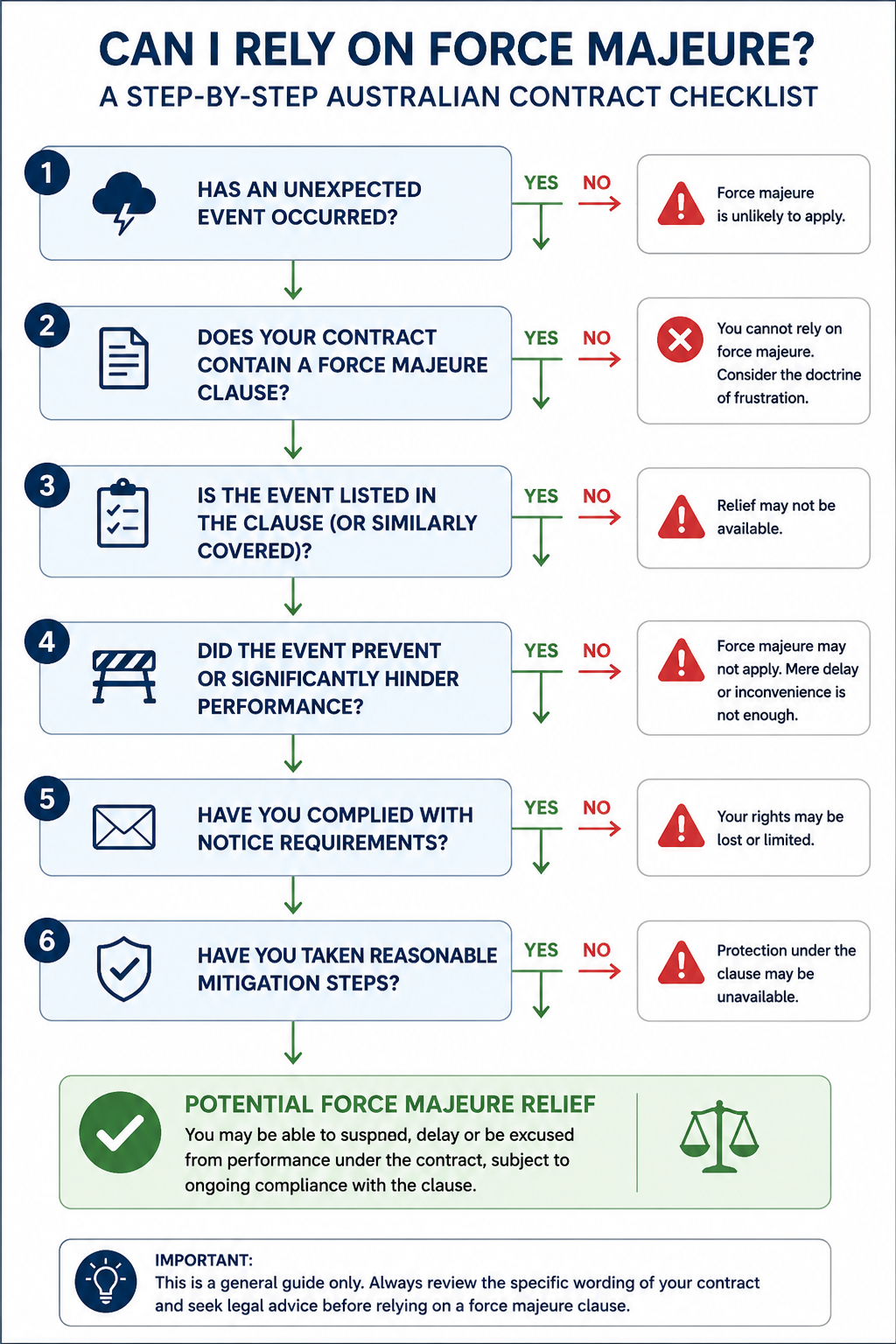
Threshold Requirements Commonly Found in Force Majeure Clauses
A party may suspend performance only if the clause authorises suspension and its applicable requirements have been satisfied. Depending on the drafting, those requirements may include a qualifying event, circumstances beyond the affected party’s reasonable control, a specified causal effect on performance, compliance with mitigation obligations, and notice within the required time and in the required form.
Why Notice Provisions Matter
Notice provisions are often critical. Clauses commonly impose timeframes for giving notice, require evidence demonstrating how the event affects performance, and impose continuing obligations to provide updates as circumstances change.
Can I stop performing immediately after a disruptive event?
Not necessarily. The contract may require notice before relief becomes available, or may impose notice and reporting obligations after the event occurs.
Failure to comply with notice, mitigation, evidence, or procedural requirements may prevent or limit reliance on the clause, particularly where compliance is expressed to be a condition of relief. The legal effect of non-compliance depends on the wording and construction of the particular provision.
What Happens If There Is No Force Majeure Clause?
If the contract does not contain a force majeure clause, the affected party cannot usually rely on force majeure as a general excuse for non-performance. The focus instead shifts to the much narrower doctrine of frustration, which may apply where a supervening event, occurring without relevant default and outside the contractual allocation of risk, makes the performance required radically different from that originally undertaken.
This is why the absence of a force majeure clause can leave a business with fewer options and a much higher threshold to overcome before suspending, delaying or ending contractual obligations.
Can the Doctrine of Frustration Apply?
If a contract does not contain a force majeure clause, a party may need to rely on the common law doctrine of frustration. Frustration may discharge a contract where a supervening event, occurring without relevant default and outside the contractual allocation of risk, makes the performance required radically different from that originally undertaken. However, the threshold is high. In Codelfa Construction Pty Ltd v State Rail Authority of NSW (1982) 149 CLR 337, the High Court confirmed that frustration only applies in limited circumstances.
Mason J emphasised in Codelfa that frustration is not lightly invoked to relieve parties from the ordinary consequences of the bargains they have made.
Why Frustration Is Difficult to Establish
Mere hardship, delay, or increased expense will rarely be sufficient. In Davis Contractors Ltd v Fareham Urban District Council [1956] AC 696, a substantial increase in time and cost did not frustrate the contract.
Lord Reid explained (at 729):
It may be that delay could be of a character so different from anything contemplated that the contract was at an end, but in this case in my opinion the most that could be said is that the delay was greater in degree than was to be expected. It was not caused by any new and unforeseeable factor or event: the job proved to be more onerous but it never became a job of a different kind from that contemplated in the contract.
The common-law doctrine determines whether a contract has been frustrated. However, the financial consequences of frustration may be affected by jurisdiction-specific legislation. For example, New South Wales has enacted the Frustrated Contracts Act 1978 (NSW). Parties should therefore consider both the governing law of the contract and any applicable statutory regime.
Drafting Force Majeure Clauses: What Should a Strong Clause Include?
The High Court has repeatedly emphasised that commercial contracts are interpreted objectively and according to the language chosen by the parties. In Mount Bruce Mining Pty Ltd v Wright Prospecting Pty Ltd (2015) 256 CLR 104, the High Court confirmed that contractual rights and liabilities are determined objectively by reference to the text, context, and purpose of the agreement. For force majeure clauses, this means that courts identify the allocation of risk created by the language of the agreement rather than reconstructing the clause by reference to what might appear fair after the event.
Essential Components of a Well-Drafted Clause
A strong force majeure clause should clearly define triggering events and specify the required causal connection, such as whether the event must “prevent”, “hinder”, or merely “delay” performance. It should also impose mitigation obligations, prescribe notice and evidence requirements, identify when performance may be suspended, allocate ongoing costs during the disruption, and provide termination rights if the event continues beyond an agreed period.
How to Allocate Risk in Commercial Contracts
The central purpose of force majeure drafting is risk allocation. Clauses should be tailored to the particular industry and transaction. For example, construction contracts may address labour shortages and regulatory delays, while supply agreements often allocate supply chain risks and require alternative sourcing. Businesses should also ensure force majeure provisions align with available insurance cover.
Should Economic Events Be Expressly Included?
If parties intend force majeure relief to apply to inflation, market disruption, sanctions, exchange control restrictions, or material shortages, those events should be expressly identified. A party should not assume that general force majeure wording will transfer ordinary economic or market risk. If protection is intended for specified economic events, the clause should identify those events and state the relief they trigger.
Common Mistakes Seen in Practice When Drafting Force Majeure Clauses
One of the most common mistakes I see in commercial contracts is parties adopting overseas precedent clauses without adapting them to Australian law or the specific transaction. Generic wording frequently creates uncertainty precisely when parties need clarity.
Another recurring issue is clauses that list force majeure events but fail to specify the consequences. Contracts often omit notice procedures, evidence requirements, or termination rights if disruption continues for an extended period. Businesses also regularly assume that increased costs automatically entitle them to suspend performance, which is rarely the case.
In supply agreements, parties commonly overlook alternative sourcing obligations and fail to coordinate force majeure provisions with indemnities, liquidated damages regimes, or insurance arrangements.
These drafting gaps frequently result in disputes, loss of contractual protection, and expensive litigation. In commercial disputes I frequently see parties focus exclusively on whether an event qualifies as force majeure while overlooking strict notice provisions or continuing performance obligations elsewhere in the contract. In many cases, the dispute is not whether a flood, pandemic, or government restriction occurred, but whether the affected party complied with procedural requirements before suspending performance. By the time legal advice is obtained, notice periods may have expired, conduct may have affected the parties’ rights, or an opportunity to preserve contractual relief may have been lost.
In practice, many force majeure disputes arise not because an event occurred, but because the contract failed to allocate the risk clearly.
Key Takeaways
Force majeure only exists if the contract creates it. Whether relief is available depends on the precise drafting and compliance with any procedural requirements that govern the availability of relief. Economic hardship alone will rarely excuse performance unless expressly addressed. Notice and mitigation obligations are often critical. If no force majeure clause exists, parties may need to rely on the much narrower common law doctrine of frustration.
Frequently Asked Questions
The following frequently asked questions address common issues involving a force majeure clause, including when a business can rely on one, what happens if the contract does not contain one, whether increased costs or supply chain disruption are enough, and what steps should be taken before suspending or terminating performance.
Can I rely on force majeure if my business cannot fulfil a contract?
Only if your contract contains a force majeure clause and the relevant event falls within its wording. You must also comply with any notice, mitigation, and procedural requirements. Without an applicable clause, failing to perform may expose you to breach of contract claims.
What happens if my contract does not contain a force majeure clause?
If there is no force majeure clause, you may need to rely on the common law doctrine of frustration. However, frustration applies only in limited circumstances where a supervening event, occurring without relevant default and outside the contractual allocation of risk, makes the required performance radically different from that originally undertaken.
Can I stop performing a contract because costs have increased?
Usually not. Increased costs, inflation, or reduced profitability will rarely excuse performance unless the contract expressly includes economic hardship as a force majeure event. Commercial inconvenience alone is generally insufficient under Australian law.
Can supply chain disruption trigger force majeure?
Possibly. Supply chain disruptions caused by events such as government restrictions, port closures, or embargoes may qualify if the contract expressly covers those events. Ordinary shortages or supplier insolvency may not be enough.
What should I do if a force majeure event affects my business?
Review the contract immediately. Check whether the event is covered, identify any notice deadlines, gather evidence of the disruption, and consider mitigation options. Delaying action may result in losing the right to rely on the clause.
Can I be sued if I wrongly rely on a force majeure clause?
Yes. If you suspend or terminate performance without a valid contractual basis, the other party may allege breach of contract and seek damages, termination rights, or other remedies.
How long do I have to give notice of a force majeure event?
The timeframe depends on the contract. Some agreements require notice within days of the event occurring. Failure to comply with a contractual notice requirement may prevent or limit relief, depending on the wording and legal effect of the provision. Businesses should therefore review the contract as soon as a disruption arises.
Does COVID-19 automatically constitute force majeure?
No. Whether COVID-19 or similar public health events constitute force majeure depends on the specific wording of the clause and how the event affected contractual performance. The existence of a pandemic alone does not automatically excuse performance.
Can a force majeure clause allow me to terminate a contract?
Many force majeure clauses permit termination if the disruptive event continues beyond a specified period. The availability of termination rights depends entirely on the contractual wording and any procedural requirements.
Should force majeure clauses include economic events?
Businesses concerned about inflation, market disruption, sanctions, exchange controls, or material shortages should consider expressly including those risks. Parties should not assume that ordinary economic or market risks fall within general force majeure wording. If relief is intended for specified economic events, those events and the resulting contractual consequences should be expressly addressed.