


How to Protect Personal Assets Before Business Failure
Many directors and business owners assume that operating through a company fully protects their personal assets from business debts. That assumption can prove costly when a personal guarantee has been signed. A personal guarantee may allow a creditor to pursue the guarantor personally if the business defaults on its obligations, potentially exposing assets that would otherwise sit outside the company’s reach.
Directors who recognise financial distress early are often in a better position to manage guarantee exposure before creditors commence recovery action. The central question is: when a business fails, what assets can creditors pursue under a personal guarantee? The answer depends on the guarantee’s terms, any associated security documents, and the guarantor’s personal asset position at the time enforcement action is taken.
What Is a Personal Guarantee?
Before taking steps to protect personal assets, it is important to identify exactly what has been signed. A guarantee may be supported by an indemnity, mortgage, charging clause or other security document, each of which can affect the creditor’s rights, the amount recoverable and the assets that may be exposed if the business cannot pay.
Why Personal Guarantees Make It Harder to Protect Personal Assets
A personal guarantee is a legally enforceable promise that an individual will repay a debt if the primary borrower fails to do so. Creditors commonly require personal guarantees where a company has limited trading history, few assets, or insufficient security to support the credit being requested.
They are frequently used for business loans, equipment finance, trade credit facilities, commercial leases, and franchise arrangements. From a creditor’s perspective, a guarantee provides an additional source of recovery if the business encounters financial difficulty.
How Personal Guarantees Can Expose Assets You Thought Were Protected
A common misunderstanding is that a guarantee only applies to a particular loan or transaction. Many guarantees are drafted as continuing guarantees that extend to future borrowing, refinancing arrangements, accrued interest, enforcement costs, and other liabilities owed to the creditor. As a result, exposure may be significantly greater than the original debt that prompted the guarantee to be signed.
A company is ordinarily responsible for its own debts. However, a personal guarantee creates a separate contractual obligation between the guarantor and the creditor. This means a creditor may pursue the guarantor personally even though the debt was incurred by the company. Personal guarantees are only one way personal liability can arise, and directors may also face exposure in circumstances involving statutory duties, insolvent trading claims, or other exceptions to limited liability.
As the High Court recognised in Yerkey v Jones [1939] HCA 3; (1939) 63 CLR 649, ordinary contractual principles generally apply where a person signs a guarantee after having the opportunity to consider its terms. In practice, once a guarantee is signed, limited liability may offer little protection against the guaranteed debt because the creditor acquires direct rights against the guarantor in addition to its rights against the company.
Latham CJ found:
The general rule is that if an adult person of ordinary understanding executes a document he (or, in modern law, she) is bound by it notwithstanding any misunderstanding by him (or by her) of its terms, unless that misunderstanding has been brought about by mutual mistake or by undue influence, fraud, or, in some cases, innocent misrepresentation or non-disclosure of material facts…
… The mortgage contained a provision that, though, as between Jones and his wife, Jones was primarily liable and Mrs. Jones was only a surety for her husband, yet as between mortgagor and mortgagee the mortgagor would be considered as a principal debtor for all principal and interest and other moneys secured. He explained that this was a clause which was necessary in the case of ‘a guarantee mortgage’ and that the effect of it was that the mortgagees could sue either Jones or Mrs. Jones or both.
Once bankruptcy becomes likely, transferring a home, savings or other property to a spouse, trust or related entity may not provide the protection anticipated. A bankruptcy trustee may investigate the transaction and, in some circumstances, seek to recover the transferred asset. Our guide explains what assets are protected in bankruptcy and when transfers may be reversed.
What Assets Can Be At Risk Under a Personal Guarantee?
Many business owners understand that a personal guarantee creates personal liability, but are unclear about exactly which assets may become exposed if the business fails. This table provides a practical overview of the asset categories creditors commonly investigate during enforcement and highlights factors that may affect recoverability.
It is particularly useful for readers searching whether their home, savings, or investments are protected after signing a guarantee.
| Asset Type | Potentially Exposed? | Important Considerations |
| Family Home | Often Yes | Particularly where supported by a mortgage or other security |
| Investment Property | Often Yes | May be targeted through judgment enforcement or secured recovery |
| Commercial Property | Often Yes | Frequently included within broader security arrangements |
| Savings Accounts | Yes | Funds may be vulnerable following judgment |
| Share Portfolios | Yes | Investments can form part of enforcement recovery |
| Managed Funds | Yes | Recoverability depends on ownership and structure |
| Future Income | Potentially | Certain enforcement processes may affect income streams |
| Jointly Owned Property | Potentially | Ownership structure may affect recovery options but does not automatically prevent action |
| Trust Interests | Depends | Requires detailed review of trust structure and control arrangements |
One of the most common questions directors and business owners ask after signing a personal guarantee is whether their home or other personal assets are at risk if the business fails. This infographic provides a simple visual overview of the types of assets creditors may pursue and highlights why guarantees can expose significantly more than just business property.

How to Protect Personal Assets Such as Your Home and Property
Real property is often the most significant asset exposed under a personal guarantee. Depending on the guarantee and any accompanying security documents, creditors may seek recovery against a family home, investment properties, or commercial property interests owned by the guarantor.
The risk increases where the guarantee is supported by a registered mortgage, security agreement, charging clause or other security interest. A caveat may also restrict dealings with property where the creditor has a caveatable interest, although the caveat itself is not usually the source of a direct power of sale.
How to Protect Personal Assets Held in Bank Accounts and Investments
A successful creditor may also pursue other personal assets, including savings accounts, share portfolios, managed investments, and other financial holdings. Many guarantors focus solely on protecting real estate while overlooking the fact that a judgment debt can be enforced against a broader range of personal assets.
Can You Protect Personal Assets and Future Income From Creditors?
Personal guarantees do not only affect existing assets. If a creditor obtains judgment against a guarantor, available enforcement processes may enable creditors to enforce against certain future earnings and assets acquired after judgment, depending on the enforcement regime and the circumstances. This can create long-term financial consequences even where the guarantor has limited assets when the business fails.
Can Joint Ownership Help Protect Personal Assets?
Spousal ownership arrangements require careful consideration. Assets held jointly may affect the method and practicality of enforcement, but joint ownership does not automatically prevent recovery. The significance of the ownership structure will depend upon factors such as whether the creditor holds security, the nature of the ownership interest, available enforcement procedures, and whether bankruptcy proceedings are ultimately commenced.
In Australia and New Zealand Banking Group Ltd v Karam [2005] NSWCA 344, the Court considered a bank’s attempt to recover company debts from the personal assets of family shareholders and directors after the company’s assets proved insufficient to meet its liabilities. The case illustrates that creditors commonly look beyond company assets when personal guarantees are available.
What Happens When the Business Defaults Under the Facility?
The ability to protect personal assets often depends on acting before the business default escalates into a formal demand, court proceeding or bankruptcy process. Once a creditor calls on a personal guarantee, the guarantor may have fewer practical options and far less negotiating leverage than they had while the business was still trading.
Protect Personal Assets Before a Guarantee Default Escalates
When a business defaults under the relevant finance, lease, or credit documents, the creditor will usually follow a predictable sequence. First, the business defaults under the loan, lease, or credit agreement. The creditor then issues a formal demand requiring payment. If the debt remains unpaid, the creditor may call upon the personal guarantee and demand payment directly from the guarantor.
Court Proceedings and the Risk to Personal Assets
If payment is not made, creditors commonly commence debt recovery proceedings against the guarantor. Where liability is clear and supported by signed guarantee documents, creditors may seek summary judgment to obtain judgment without a full trial. Once judgment is entered, state enforcement legislation may permit recovery through various enforcement processes against the guarantor’s assets.
Protect Personal Assets Before Guarantee Debt Leads to Bankruptcy
A personal guarantee can ultimately expose a guarantor to bankruptcy. Following judgment, a creditor may seek to utilise the bankruptcy regime established under the Bankruptcy Act 1966 (Cth), including the issuance of a bankruptcy notice and, where appropriate, the presentation of a creditor’s petition seeking a sequestration order. The consequences of bankruptcy may include the vesting of divisible property in a trustee, restrictions on company management, and ongoing disclosure obligations.
The practical reality is that creditors frequently pursue guarantors after business assets prove insufficient. In Australia and New Zealand Banking Group Ltd v Karam [2005] NSWCA 344, the bank sought recovery from the personal assets of directors and shareholders when the company’s assets could not satisfy its liabilities.
Can a Personal Guarantee Ever Be Challenged?
A person seeking to protect personal assets should not assume that an unfavourable guarantee can simply be set aside after financial difficulties arise. Challenges may be available in limited circumstances, but the outcome will usually depend on the guarantee’s wording, how it was signed, what information was provided, and whether there was any unfair conduct surrounding the transaction.
Common Grounds Raised by Guarantors
A personal guarantee will not be unenforceable merely because the transaction later proves financially disastrous. However, Australian courts may intervene where a guarantee was obtained in circumstances involving unconscionable conduct, particularly where the creditor knew or ought to have known that the guarantor suffered from a special disadvantage affecting their ability to make an informed judgment.
In Commercial Bank of Australia Ltd v Amadio (1983) 151 CLR 447, the High Court set aside a guarantee given by elderly parents who did not properly understand the nature and extent of the transaction and whose disadvantage was sufficiently apparent to the bank. The decision remains a leading authority demonstrating that guarantees may be challenged where informed consent is lacking and enforcement would be unconscientious in all the circumstances.
Deane J found at 474:
The jurisdiction is long established as extending generally to circumstances in which (i) a party to a transaction was under a special disability in dealing with the other party with the consequence that there was an absence of any reasonable degree of equality between them and (ii) that disability was sufficiently evident to the stronger party to make it prima facie unfair or ‘unconscientious’ that he procure, or accept, the weaker party’s assent to the impugned transaction in the circumstances in which he procured or accepted it…
Why Challenges Often Fail
Many guarantors underestimate the difficulty of setting aside a signed guarantee. Courts generally enforce clearly drafted guarantees that have been properly executed. A common mistake is assuming that financial pressure, a poor commercial outcome, or a lack of understanding of the business’s financial position will automatically invalidate the guarantee. In many cases, those factors alone are insufficient.
In Australia and New Zealand Banking Group Ltd v Karam [2005] NSWCA 344, the Court emphasised that directors who understood the nature and effect of the documents they signed could be held to them even where the company was in serious financial difficulty.
The Court found at [92–95]:
…The Karams understood the nature and effect of the action they were taking and took it because they understood it was necessary in order to obtain further financial accommodation, essential to the continued operation of the Company…
…The perilous financial circumstances of the Company were not the Bank’s doing so there was no basis for saying that the Bank, in a legal sense, subjected the Karams to pressure. Rather, it was the Karams who were seeking that the Bank provide additional credit, without which the Company would have to cease trading
Special Issues Involving Spouses and Family Members
Additional protections may arise where spouses or family members provide guarantees for another person’s business debts without receiving a direct benefit. The High Court’s decisions in Yerkey v Jones [1939] HCA 3; (1939) 63 CLR 649 and Garcia v National Australia Bank Ltd [1998] HCA 48; (1998) 194 CLR 395 recognise circumstances in which guarantees may be set aside where a volunteer guarantor did not properly understand the transaction. Independent legal advice is often a critical factor when courts assess whether informed consent was genuinely obtained.
Common Mistakes I See in Practice When Personal Guarantees Are Signed
The most effective way to manage guarantee risk is before signing the documents. Many enforcement disputes arise because directors focus on obtaining finance and overlook the scope of the security being provided. This checklist highlights the issues that most frequently cause problems when businesses later encounter financial difficulty.
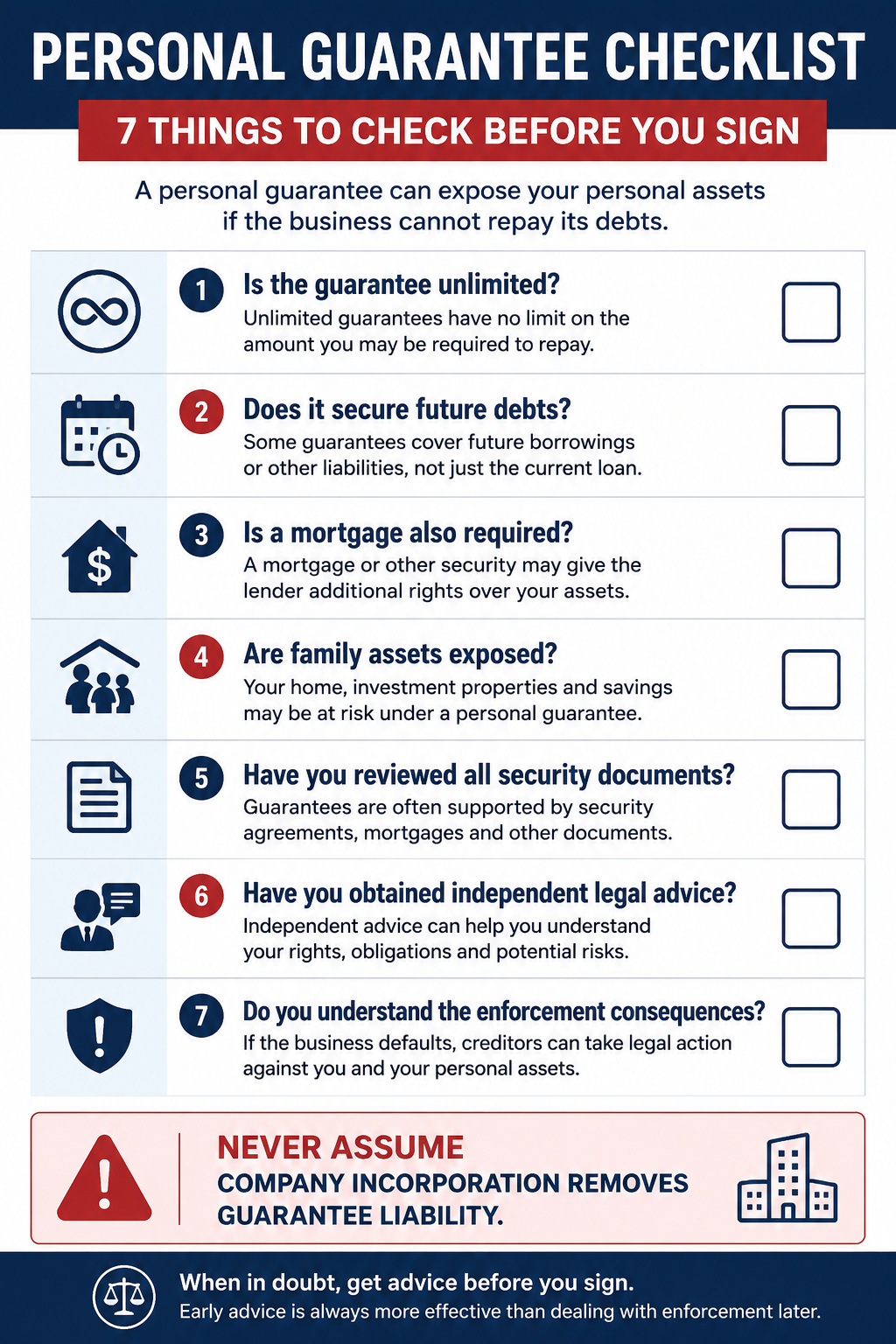
Assuming the Company Structure Provides Complete Protection
One of the most common misconceptions I encounter is the belief that incorporation completely eliminates personal risk. Many directors spend considerable time establishing a company structure but then unknowingly assume personal liability through a guarantee signed years earlier.
Signing Banking Documents Without Reviewing Security Documents
In guarantee disputes, one issue that frequently emerges is that the client carefully reviewed the loan amount and repayment obligations but never appreciated that separate security documents were being signed at the same time. In many matters, the practical enforcement risk arises not from the guarantee itself but from a supporting mortgage, all-assets security agreement, or charging clause that substantially expands the creditor’s recovery options if the business later fails.
Delaying Advice Until Enforcement Has Started
Another recurring mistake is waiting until a demand letter, statutory demand, bankruptcy notice, or court proceeding has been received. By that stage, negotiating leverage is often reduced and available options may be more limited.
Asset Transfers After Financial Difficulties Emerge
I also regularly see directors transfer assets to spouses, trusts, or related entities after financial problems become apparent. These transactions can attract close scrutiny if creditors, liquidators, or bankruptcy trustees later investigate whether assets were moved beyond the reach of recovery action. Transactions undertaken after financial difficulties emerge often create significantly greater legal risk than asset structuring undertaken before liabilities arise.
Early advice is usually far more effective than attempting to restructure assets after enforcement risks have already emerged.
Key Takeaways
Personal guarantees can expose directors, business owners, and other guarantors to substantial personal liability for company debts. Depending on the guarantee and any supporting security, family homes, investment properties, savings, and other assets may be at risk. Creditors frequently continue enforcement action even after a business has failed or entered liquidation. Although guarantees can sometimes be challenged, successful claims are usually highly fact-specific.
In practice, obtaining legal advice before legal action or enforcement action begins often provides significantly more options than responding after demands, court proceedings, or bankruptcy processes have already commenced.
Frequently Asked Questions
The following frequently asked questions address common concerns about how to protect personal assets after signing a personal guarantee, including whether creditors can pursue a family home, jointly owned property, savings, future income, trust interests or assets transferred to a spouse.
Can I be sued personally for a company debt if I signed a personal guarantee?
Yes. A personal guarantee creates a separate contractual obligation between you and the creditor. If the company defaults, the creditor may pursue you personally for the guaranteed debt, even though the company was the original borrower.
What happens if my business fails and I cannot pay under a personal guarantee?
The creditor may issue a demand, commence court proceedings, obtain judgment, and take enforcement action against your assets. In some cases, unpaid guarantee debts can also lead to bankruptcy proceedings.
Can a creditor take my family home under a personal guarantee?
Potentially, yes. If the guarantee is supported by a mortgage or other security over the property, the family home may be exposed. Even without a mortgage, a judgment creditor may have enforcement options depending on the circumstances.
Can I challenge a personal guarantee after signing it?
Possibly. Challenges may arise where there was misrepresentation, undue influence, unconscionable conduct, or defects in how the guarantee was executed. However, courts generally enforce properly drafted and properly signed guarantees.
What should I do if I receive a demand under a personal guarantee?
Do not ignore it. Review the guarantee and any supporting security documents immediately and obtain legal advice. Early action may identify negotiation opportunities, potential defences, or ways to minimise enforcement risks.
Can a spouse be liable under a personal guarantee for a business they do not run?
Yes. A spouse who signs a personal guarantee may become personally liable even if they have no involvement in the business. The extent of liability depends on the guarantee’s terms and the surrounding circumstances.
Are jointly owned assets protected from a personal guarantee claim?
Not necessarily. Joint ownership can affect enforcement options, but it does not automatically prevent recovery action. The outcome depends on the ownership structure, the asset involved, and the creditor’s available remedies.
How long does a creditor have to enforce a personal guarantee?
The applicable limitation period depends on the nature of the claim and the relevant state or territory legislation. Creditors often have several years to commence proceedings, so guarantees can remain a significant long-term risk.
Can I transfer assets to my spouse if I am worried about guarantee enforcement?
Extreme caution is required. Asset transfers made after financial difficulties emerge may later be challenged by creditors, liquidators, or bankruptcy trustees if they appear designed to defeat recovery action.
Can a personal guarantee lead to bankruptcy?
Yes. If a creditor obtains judgment and the debt remains unpaid, it may issue a bankruptcy notice under the Bankruptcy Act 1966 (Cth). Continued non-payment can result in a creditor’s petition seeking to make you bankrupt.