


What Is a Mortgagee Sale
A mortgagee sale occurs when a lender exercises its contractual and statutory right to sell secured property after a mortgage default. Borrowers who want to stop a mortgagee sale should understand that this power usually arises only after earlier enforcement steps have already occurred. The purpose of the sale is to recover the debt owed to the lender rather than to obtain ownership of the property itself. In Queensland, the power of sale arises from both the mortgage terms and the Property Law Act 2023 (Qld). Most mortgages allow a lender to enforce its security where repayments are missed or other obligations are breached. A mortgagee sale is usually the final stage of a broader enforcement process rather than the first response to financial difficulty.
Borrowers frequently confuse default notices, possession proceedings and mortgagee sales. They are distinct steps. A default notice identifies the alleged breach and provides an opportunity to remedy it. Possession proceedings are directed at obtaining control of the property. A mortgagee sale is the process by which the property is ultimately sold, and the proceeds are applied towards the debt.
Are you struggling with pressure from creditors or the bank? If you require legal assistance regarding this, contact one of our experienced team of insolvency professionals and let us help you protect your rights.
What is a Notice of Exercise of Power of Sale?
A notice relating to the exercise of a mortgagee’s power of sale is a formal communication advising that the lender intends to exercise enforcement rights because a default remains unresolved. The terminology used may vary depending on the mortgage documents, the applicable legislation and the stage of enforcement.
From a practical perspective, receipt of the notice is important because it usually means the lender has already completed significant internal review processes. Earlier demands, arrears management procedures, and assessments often occur before the notice is issued. Many borrowers mistakenly assume that the notice marks the beginning of enforcement when, in reality, it often indicates that enforcement is already well advanced.
When Can a Mortgagee Sell Property in Queensland?
A lender’s ability to sell mortgaged property depends upon both the mortgage contract and the applicable statutory framework. Generally, there must be an enforceable default and compliance with any applicable notice requirements before the power of sale can be exercised. The typical sequence involves default, formal demand or notice, expiry of the period to remedy the default, exercise of enforcement rights, and eventual sale. Although a mortgagee may exercise the power of sale for its own benefit, the power is not unfettered. In Forsyth v Blundell [1973] HCA 20; (1973) 129 CLR 477, Menzies J reaffirmed the longstanding principle that a mortgagee must act in good faith when exercising its power of sale. His Honour stated at [481]:
… if a mortgagee in exercising his power of sale exercises it in good faith, without any intention of dealing unfairly by his mortgagor, it would be very difficult indeed, if not impossible, to establish that he had been guilty of any breach of duty towards the mortgagor… Of course, if he wilfully and recklessly deals with the property in such a manner that the interests of the mortgagor are sacrificed, I should say that he had not been exercising his power of sale in good faith.
This remains one of the leading Australian statements of the obligations imposed upon mortgagees exercising a power of sale.
A lender exercising a power of sale cannot simply dispose of the property without regard to its value. If the property is sold substantially below market value, the borrower may have grounds to question whether the mortgagee took reasonable care during the sale. We explain when an undervalued mortgagee sale may support a claim against the bank.
Can You Stop a Mortgagee Sale After Receiving the Notice?
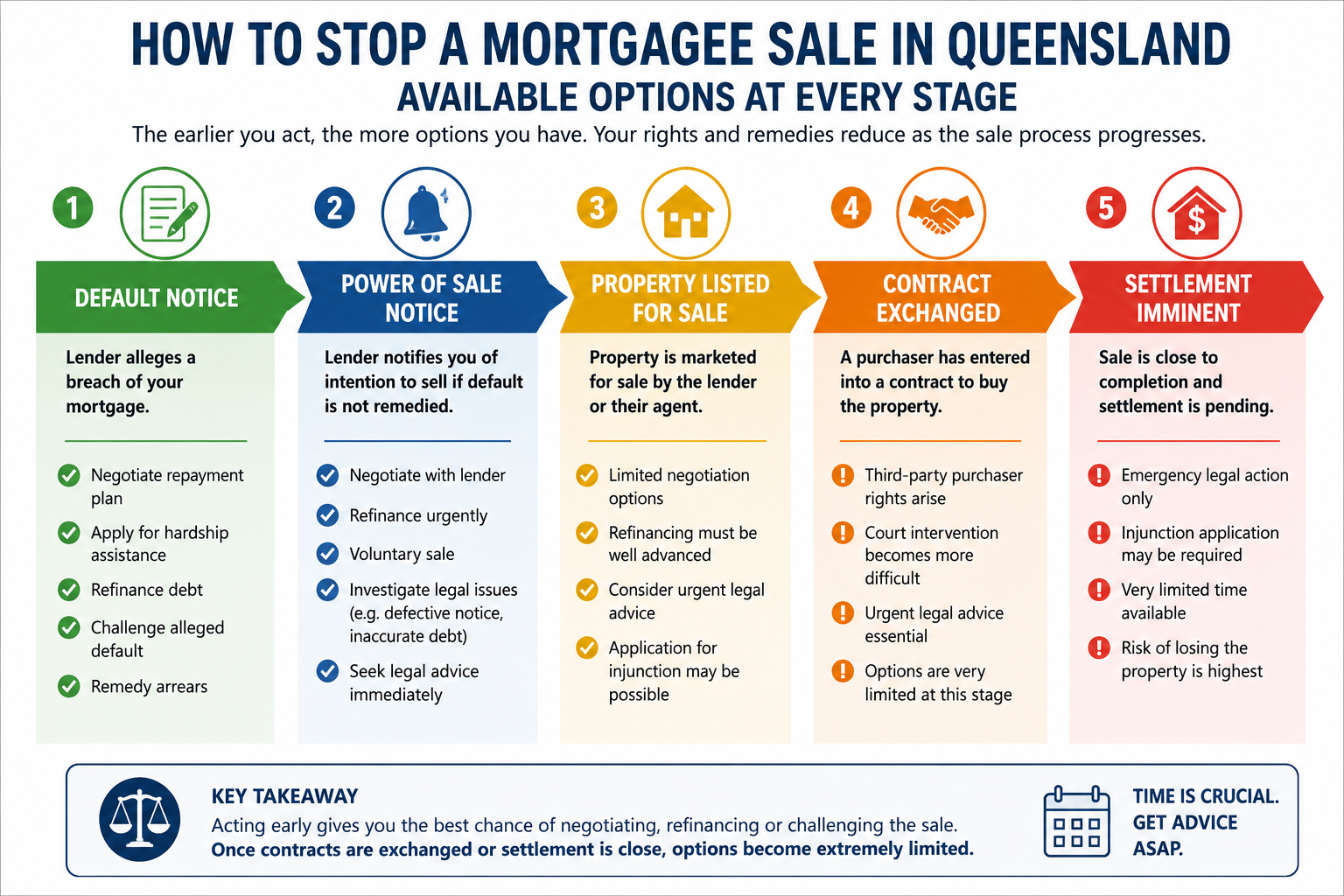
The short answer is yes, but only in some circumstances. The practical options available to borrowers change significantly as enforcement progresses. Understanding where a matter sits within the mortgagee enforcement process is often critical when assessing whether negotiation, refinancing, voluntary sale, or court intervention remains realistic.
Receiving a Notice of Exercise of Power of Sale does not automatically mean the property will be sold. Depending on the facts, borrowers may be able to negotiate with the lender, refinance, sell the property voluntarily, challenge aspects of the enforcement process or seek urgent court intervention. However, there is no automatic right to stop a mortgagee sale. One of the most common misconceptions is that a court will intervene simply because a family home is at risk. Mortgagees are generally entitled to enforce valid security rights. The critical question is whether there is a legal basis to prevent or delay the sale.
The Earlier Action Is Taken, the Better the Prospects
Timing often has a greater impact than the strategy ultimately adopted. At the default notice stage, options are relatively broad. Borrowers may still be able to negotiate, refinance or rectify the alleged default. Once a Notice of Exercise of Power of Sale has been issued, options remain available but become more limited. After marketing begins and substantial enforcement costs are incurred, lenders are often less willing to postpone the process. Once contracts have been exchanged with a purchaser, additional rights arise, and any attempt to restrain the sale becomes significantly more difficult.
Why Timing Often Determines the Outcome
Mortgagee sales rarely affect only the borrower and lender. Once purchasers become involved, courts must also consider third-party interests. Courts are generally reluctant to interfere with completed transactions or disrupt a sale process without a clear legal basis. The High Court’s decisions in Beecham Group Ltd v Bristol Laboratories Pty Ltd [1968] HCA 1; (1968) 118 CLR 618 and Australian Broadcasting Corporation v O’Neill [2006] HCA 46; (2006) 227 CLR 57 establish the principles governing interlocutory injunctions. These authorities emphasise the need for a proper legal claim, consideration of the balance of convenience and a careful assessment of whether intervention is justified.
Emergency Legal Options When Your House Is About to Be Sold
Many borrowers focus on preventing a mortgagee sale without considering whether a voluntary sale could yield a better commercial outcome. In some circumstances, voluntarily selling the property can reduce enforcement costs, preserve equity, and minimise exposure to future debt recovery action. This comparison highlights the practical differences between the two approaches.
| Issue | Voluntary Sale | Mortgagee Sale |
| Control of Sale Process | Borrower retains significant control over the timing and process | Lender controls the sale process |
| Choice of Selling Agent | Usually selected by the borrower | Usually appointed by the mortgagee |
| Ability to Negotiate Sale Terms | Greater flexibility in pricing and negotiations | Limited borrower involvement |
| Marketing Strategy | Borrower can influence advertising and presentation | Determined by the lender or appointed agent |
| Enforcement Costs | Often lower | Often higher due to enforcement expenses |
| Risk of Shortfall Debt | May be reduced if a higher sale price is achieved | Potentially higher if sale proceeds are insufficient |
| Timing Flexibility | Greater ability to manage sale timing | Timing driven by lender requirements |
| Opportunity to Preserve Equity | Often better opportunity to maximise sale proceeds | Less control over maximising value |
| Borrower Involvement | Active participation throughout the process | Limited involvement once enforcement commences |
| Overall Financial Outcome | Often produces a more favourable commercial outcome where achievable | May result in higher costs and greater financial exposure |
Even after a power of sale notice has been issued, several options may still be available.
Negotiating with the Mortgagee
Direct negotiation is often the first avenue worth exploring. Depending on the circumstances, a lender may consider repayment arrangements, hardship proposals, refinancing timeframes or temporary postponements. Lenders are generally more receptive when a borrower can produce evidence showing how the default will be resolved. Vague promises are rarely persuasive. Documentary support, such as finance approvals, evidence of asset sales or proof of incoming funds, is usually far more effective.
Refinancing Before Sale
Refinancing can be one of the most effective ways to stop a mortgagee sale because it addresses the lender’s primary concern: repayment. The key issue is demonstrating a genuine capacity to discharge the debt. Borrowers frequently state that they are exploring refinancing options but have not secured any form of approval. From the lender’s perspective, this often carries little weight. Evidence such as finance approvals, valuations and realistic settlement timeframes can be important.
Selling the Property Yourself
In some circumstances, a voluntary sale may achieve a better outcome than a mortgagee sale. Mortgagees sometimes agree to postpone enforcement where the borrower can demonstrate that the property is actively being marketed and is likely to sell within a reasonable timeframe. A voluntary sale may achieve a higher price, reduce enforcement costs and minimise the risk of a shortfall debt.
Challenging the Enforcement Process
Some borrowers may have grounds to challenge aspects of the enforcement process. Potential issues include notice defects, calculation errors, procedural irregularities, disputes regarding the alleged default, or failures to comply with contractual or statutory obligations. Importantly, not every disagreement regarding price or process will justify intervention. As Menzies J explained in Forsyth v Blundell [1973] HCA 20; (1973) 129 CLR 477 at 481:
To take reasonable precautions to obtain a proper price is but a part of the duty to act in good faith.
Accordingly, the focus is usually on whether the mortgagee has acted in good faith and taken appropriate steps in exercising the power of sale, rather than on whether a borrower can identify a theoretically better outcome.
However, not every error will justify intervention. Whether a defect is sufficiently significant depends on the nature of the issue and its practical effect on the enforcement process.
Urgent Injunctions to Stop a Mortgagee Sale
Courts do not grant injunctions simply because a borrower faces hardship. A borrower seeking to restrain a mortgagee sale must establish recognised legal grounds for relief and satisfy the principles governing interlocutory injunctions. An injunction is often regarded as the last available option where a sale is imminent. An interlocutory injunction is a temporary order designed to preserve the parties’ positions until a dispute can be determined. It does not finally decide whether the mortgagee is entitled to sell the property. Instead, it determines whether the sale should be paused while legal issues are resolved.
When Will a Court Consider Stopping a Mortgagee Sale?
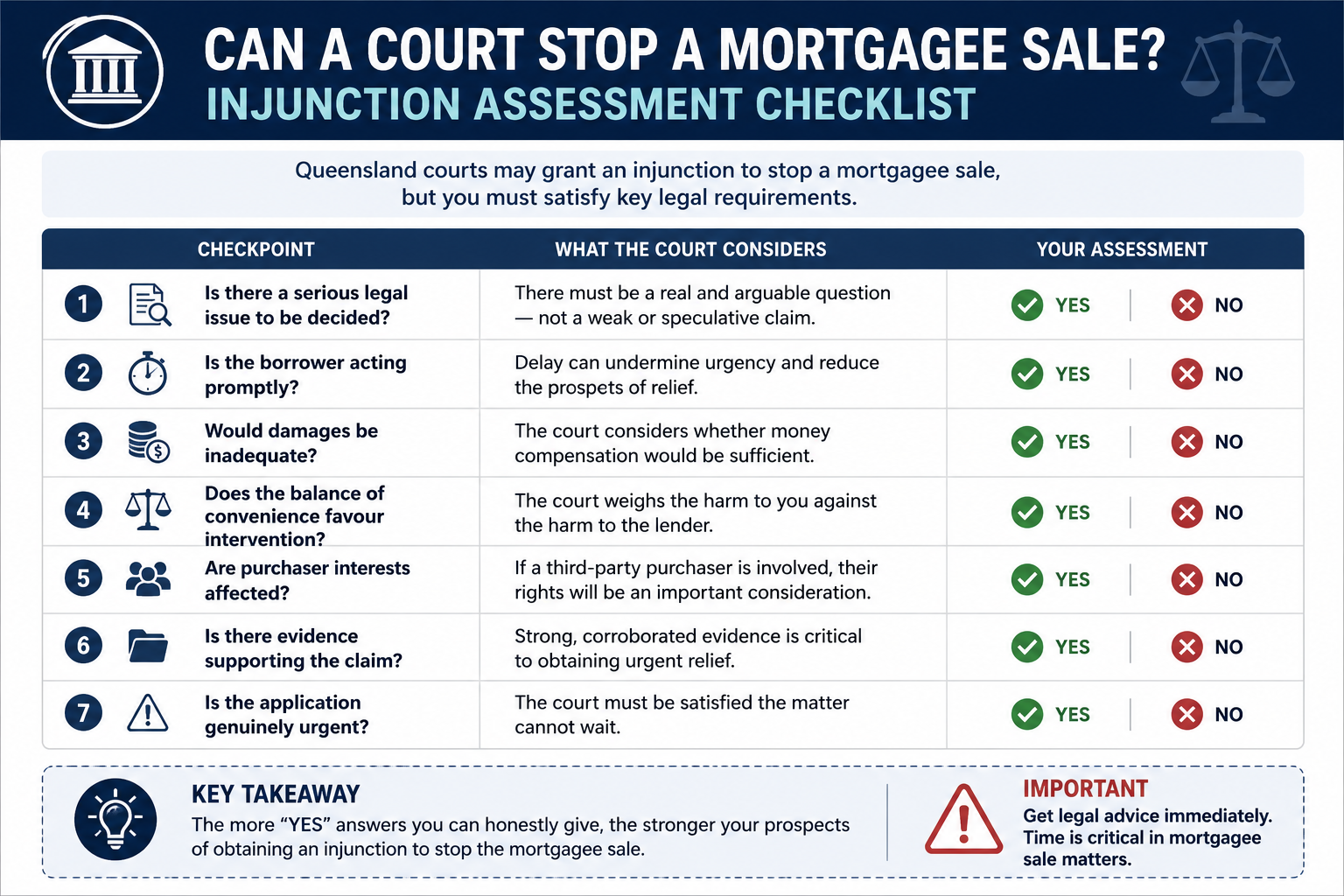
The applicant must generally establish a serious question to be tried, demonstrate that the balance of convenience favours intervention and show that damages may not be an adequate remedy. A serious question to be tried requires more than a speculative complaint. There must be a genuine legal issue requiring determination. In Australian Broadcasting Corporation v O’Neill [2006] HCA 46; (2006) 227 CLR 57, Gleeson CJ and Crennan J explained that interlocutory relief requires consideration of:
“a sufficient colour of right to final relief to justify the grant of an interlocutory injunction” together with considerations of damages and “the balance of convenience”
In practical terms, borrowers must identify a genuine legal basis for challenging the proposed sale rather than merely asserting hardship or dissatisfaction. The balance of convenience involves weighing the prejudice to the borrower if the sale proceeds against the prejudice to the lender and any third parties if the sale is delayed. In Beecham Group Ltd v Bristol Laboratories Pty Ltd [1968] HCA 1; (1968) 118 CLR 618, McTiernan J described “the relative convenience or inconvenience to the parties of granting or withholding an injunction” as a “most important consideration”.
In mortgagee sale disputes, this balancing exercise frequently becomes more difficult once purchasers have exchanged contracts or settlement is approaching. The adequacy of damages requires consideration of whether monetary compensation could properly address any loss suffered.
Circumstances That May Justify an Injunction
Potential examples include significant defects in notices, genuine disputes regarding default, substantial disputes concerning the amount owing, alleged failures to comply with statutory requirements, serious valuation concerns or allegations of unconscionable conduct. Borrowers should not assume that every dispute will justify urgent relief. Courts generally require evidence demonstrating that the issue materially affects the mortgagee’s entitlement to proceed.
Evidence Usually Required
Urgent applications are evidence-driven. Common forms of evidence include affidavits, loan statements, repayment histories, correspondence, valuation reports and evidence of an ability to remedy the default. Where refinancing is relied upon, courts often expect evidence demonstrating that finance is realistically available rather than merely speculative.
Why Last-Minute Applications Are Difficult
Many applications arise only after marketing has commenced or settlement is imminent. Courts are often less sympathetic where urgency has been created by the applicant’s own delay. This reflects the broader equitable principle that interlocutory relief is discretionary and requires a careful balancing of competing interests. As the High Court recognised in Beecham Group Ltd v Bristol Laboratories Pty Ltd [1968] HCA 1; (1968) 118 CLR 618, the court must assess the relative convenience and inconvenience of intervention.
In practice, a borrower who waits until the final days before settlement frequently faces greater difficulty persuading the court that urgent intervention is justified. Third-party purchaser interests also become increasingly important as the transaction progresses. Once contracts have been exchanged, courts must consider the rights of purchasers who may have acted in good faith and incurred substantial expense.
Can You Stop a Mortgagee Sale Days Before It Happens?
Technically, yes. Practically, it is much harder. The closer a matter gets to completion, the more difficult it becomes to persuade a court that intervention is justified. Courts will consider delay, prejudice to the lender, the purchaser’s interests and the strength of the underlying claim. If contracts have already been exchanged, the dispute is no longer solely between borrower and lender.
Purchasers may have paid deposits, arranged finance and altered their position in reliance upon the transaction proceeding. This creates additional complexity and often increases judicial reluctance to interfere. Where settlement is only days away, applications frequently become emergency matters requiring urgent preparation, affidavit evidence and rapid court listings.
Can You Get an Urgent Court Order to Stop the Sale?
Urgent applications to restrain a mortgagee sale are generally brought in the Supreme Court of Queensland, which possesses broad equitable jurisdiction to grant interlocutory injunctions where appropriate. In practice, borrowers seeking to prevent an imminent mortgagee sale commonly apply to the Supreme Court because the relief sought involves the exercise of equitable powers to preserve the status quo pending determination of the underlying dispute.
The Court’s jurisdiction to grant interlocutory injunctions is well established, and the principles governing such applications have been authoritatively considered by the High Court in Beecham Group Ltd v Bristol Laboratories Pty Ltd [1968] HCA 1; (1968) 118 CLR 618 and Australian Broadcasting Corporation v O’Neill [2006] HCA 46; (2006) 227 CLR 57.
The Court has broad equitable jurisdiction and can hear genuinely urgent matters within short timeframes where circumstances justify intervention. Applicants must generally establish a legal basis for relief, provide supporting evidence and demonstrate genuine urgency. There are also risks. Unsuccessful applicants may face costs orders. Courts commonly require an undertaking as to damages, meaning the applicant may be required to compensate affected parties if it later emerges that the injunction should not have been granted. Weak applications can also reduce negotiating leverage and increase overall costs.
What Happens If You Do Nothing Before a Mortgage Sale?
Doing nothing is often the highest-risk response. If no action is taken, the mortgagee will generally proceed with marketing, contract formation, and settlement. Once settlement occurs, ownership is transferred, and sale proceeds are applied to the debt.
The practical ability to reverse the transaction often diminishes significantly once third-party purchasers become involved. Courts place considerable weight on the finality of completed transactions. In Latec Investments Ltd v Hotel Terrigal Pty Ltd (in liq) [1965] HCA 17; (1965) 113 CLR 265, the High Court considered the circumstances in which a completed mortgagee sale could be challenged where the mortgagee had allegedly acted improperly. The decision illustrates that although relief may sometimes be available, unwinding completed transactions can become significantly more complex once third-party rights arise.
The Debt May Continue After the Sale
A mortgagee sale does not necessarily eliminate the borrower’s liability. If sale proceeds are insufficient to discharge the debt, the borrower may remain liable for the balance. This is commonly known as a shortfall or deficiency debt. Where a substantial shortfall remains, lenders may pursue debt recovery proceedings, enforcement action or bankruptcy processes. Interest and legal costs may continue to accrue, increasing overall exposure.
In Commercial and General Acceptance Ltd v Nixon [1981] HCA 70; (1981) 152 CLR 491, the High Court confirmed that a mortgagee is not a trustee for the mortgagor when exercising a power of sale. As Gibbs CJ stated at [494], a mortgagee is:
not a trustee of the power of sale for the mortgagor
However, Commercial and General Acceptance Ltd v Nixon and Forsyth v Blundell make clear that mortgagees must still act in good faith and comply with their legal obligations when exercising enforcement rights. A borrower considering whether to challenge a sale should therefore focus on whether those obligations have been breached rather than merely asserting that a higher price could have been achieved.
Common Mistakes We See in Mortgagee Sale Matters
The first mistake is treating the Notice of Exercise of Power of Sale as just another reminder. By the time the notice is issued, enforcement may already be well advanced.
The second is waiting until marketing begins before seeking advice. In practice, I frequently see borrowers approach lawyers only after agents have been appointed and inspections scheduled. By that stage, lenders have often incurred high costs and become less receptive to postponement requests that may have been considered weeks earlier. Earlier intervention usually preserves more options.
The third is focusing on arrears rather than evidence. Borrowers often believe the lender’s figures are wrong but cannot produce statements, emails, payment records or other supporting material.
Another common misconception is that courts will automatically stop a sale because hardship exists. Hardship may be relevant, but injunctions require a legal basis and evidence.
Finally, many borrowers focus exclusively on retaining ownership and overlook the risk of a debt shortfall. Even if the property is sold, financial consequences may continue through debt-recovery actions or bankruptcy proceedings.
Practical Considerations Before Taking Action
One recurring theme in mortgagee sale matters is that borrowers often focus exclusively on whether the lender can be stopped, rather than evaluating the broader commercial outcome. In some cases, preserving ownership is realistic. In others, the better strategy may be to maximise sale value, minimise any shortfall debt and avoid future enforcement proceedings. The correct approach depends on available equity, refinancing prospects, income, and the strength of any legal challenge.
Borrowers should also recognise that lenders generally assess both conduct and financial capacity. A borrower who communicates promptly, responds to requests for information and presents a realistic proposal is often in a stronger position than a borrower who ignores correspondence until the final stages of enforcement. While lenders are not required to postpone a sale, practical engagement can sometimes create opportunities that would otherwise be unavailable.
Another issue frequently overlooked is evidence preservation. Account statements, hardship applications, emails, letters, payment receipts and records of conversations may become important if the enforcement process is challenged. Gathering those materials early is generally easier than attempting to reconstruct events months later.
Borrowers should also be cautious about relying on informal advice. Mortgage enforcement disputes are highly fact-specific. The legal significance of a notice defect, valuation concern or repayment dispute often depends on detailed facts that are not immediately obvious. Ultimately, the strongest position is usually achieved by combining legal analysis with commercial strategy. Understanding whether a viable challenge exists is important, but so too is understanding the likely financial consequences if the sale proceeds.
An additional practical consideration: borrowers should assess whether preserving the property is financially sustainable over the long term. Even where a sale can be delayed, the underlying debt problem may remain unresolved. A realistic review of future repayment capacity, refinancing prospects, and overall financial exposure is often as important as any immediate legal response.
Conclusion
A Notice of Exercise of Power of Sale is a serious escalation in the enforcement process, but it does not necessarily mean a sale is inevitable. Borrowers may still have options, including negotiation, refinancing, voluntary sale, legal challenges and urgent court applications. The critical issue is timing.
As the matter progresses toward marketing, contract exchange and settlement, available remedies become narrower and more difficult to pursue. Borrowers who understand their rights early, gather evidence promptly and act without delay are generally in a far stronger position than those who wait until the final stages of the process.
Frequently Asked Questions
The following frequently asked questions address common concerns about how to stop a mortgagee sale in Queensland, including what a Notice of Exercise of Power of Sale means, how much time borrowers may have, whether urgent court orders are available, what happens if the notice is ignored, and how shortfall debt may arise after the property is sold.
Can I stop a mortgagee sale after receiving a Notice of Exercise of Power of Sale?
Possibly. Receiving a Notice of Exercise of Power of Sale does not automatically mean your property will be sold. Depending on the circumstances, options may include negotiating with the lender, refinancing, voluntarily selling the property, challenging aspects of the enforcement process, or seeking urgent court intervention.
How long do I have to stop a mortgagee sale?
There is no single timeframe that applies to every matter. The available time depends on the mortgage terms, the stage of enforcement, and whether the property has been listed, placed under contract, or is approaching settlement. Acting immediately after receiving the notice generally preserves the greatest number of options.
Can I get an urgent court order to stop a mortgagee sale?
Yes, in some circumstances. A Queensland court can grant an injunction preventing a mortgagee sale from proceeding. However, you must usually establish a genuine legal basis for relief, provide supporting evidence, and demonstrate that the balance of convenience favours intervention.
What happens if I ignore a Notice of Exercise of Power of Sale?
If you do nothing, the lender may continue the enforcement process and proceed with marketing, sale, and settlement of the property. Delaying action often reduces the practical and legal options available to challenge or postpone the sale.
Can a bank sell my house without going to court in Queensland?
In many cases, yes. Depending on the mortgage terms and compliance with relevant legal requirements, a lender may be able to exercise its power of sale without first obtaining a court order. The specific circumstances of the mortgage and enforcement process will be important.
Can I stop a mortgagee sale by paying the arrears?
Sometimes, but not always. The outcome depends on the amount owed, the lender’s position, and how far the enforcement process has progressed. Once significant enforcement costs have been incurred or contracts have been exchanged, simply paying arrears may not resolve all outstanding issues.
What happens if my house sells for less than the mortgage debt?
You may remain liable for the shortfall. If the sale proceeds are insufficient to repay the debt, interest, and recoverable costs, the lender may pursue you for the remaining balance through ordinary debt recovery processes.
Can I challenge a mortgagee sale because the property was sold too cheaply?
Possibly. Mortgagees must act in good faith and comply with their legal obligations when exercising a power of sale. However, the fact that a property may have achieved a higher price is not, by itself, enough to establish a successful challenge.
Can I stop a mortgagee sale after contracts have been exchanged?
It may still be possible, but it becomes significantly more difficult. Once a third-party purchaser acquires contractual rights, courts must consider the interests of the purchaser as well as those of the borrower and lender. Urgent action is usually required.
What should I do if my house is about to be sold by the mortgagee?
Act immediately. Gather relevant documents, including notices, loan statements, payment records, and correspondence with the lender. The earlier the situation is assessed, the more options may be available to negotiate, refinance, challenge the enforcement process, or seek urgent court relief.